Gallipoli
Aim / Why Gallipoli?
Attack Turkey to get Germany to reroute troops there instead of the Western Front.
The plan was to bomb the peninsula and then land troops on the beaches, as well as clear the Dardanelles to get supplies through to Russia. Initially it was planned to be a purely naval expedition, but because of mines and bombardments by the Turks more ships were lost than expected, so an ill-prepared land attack was commanded.
This gave the Turks many weeks of advance preparation and the ANZAC troops also landed at the wrong beach.
Landing - April 25 1915
Who was there?
- ANZAC troops
- British troops
- French troops
- Other nations’ troops.
- Turkish troops (Enemy)
Locations
- ANZAC Cove
- Gallipoli Peninsula.
- They were meant to land at Gaba Tepe and capture
- Hill 971, but landed in the wrong place at Anzac Cove.
They didn’t get any further in the entire campaign than they did on the first day.
Conditions
- Disease was common in the trenches, where diarrhoea, dysentery and paratyphoid infected thousands.
- Men were fainting at their posts and had vermin attacking them regularly.
- While water was continuously being shipped in from Egypt, it wasn’t enough for the soldiers to be functioning effectively.
- It was unbearably hot and arid in the summer months.
- Dead bodies were left to decompose in no man’s land until a temporary armistice could be arranged.
What Happened?
At dawn on the 25th April 1915, 16,000 ANZAC troops landed on the Gallipoli Peninsula. They were faced with steep cliffs instead of a soft beach, where Turks were able to fire on the invading forces as they arrived on shore.
During the first day ANZAC troops forced their way 900 metres on shore; over 600 were killed and 2000 wounded. By the end of April, 27,000 troops had landed and trench warfare had begun.
Lone Pine and The Nek
As Summer started two new offensives were planned, one at Lone Pine where Australians would distract the Turks from the other offensive where Brits were landing at Suvla Bay.
On 7 August 1915 the 3rd Light Horse Brigade attacked the Turks over a distance of 30 metres but was decimated by machine gun fire. Tragically, commanders believed the Brigade had successfully reached the Turks and dispatched additional troops in what would be a futile attempt. The charge of the 3rd Light Horse Brigade is one of the most famous and tragic battles, resulting in the deaths of 230 men in 45 minutes.
Withdrawal
By the time December rolled around and it was clear the the Galipoli campaign had failed, the order was sent to withdraw. Over two nights the troops were evacuated with only two casualties.
The Aftermath
A costly defeat for the Allies, it had basically no impact on the war, but had 142,000 killed our wounded and 26,111 Australian casualties including 8.141 deaths.
Questions
- How did the first wave of ANZACS react to the landing?
With excitement, perseverance and courage. They leapt into action before commanded and kept on moving, even as they lost soldiers. - How are the soldiers portrayed? Is this a reliable version of events?
The soldiers are portrayed as courageous and persevering, I think this may have been accurate for the first wave, though I don’t know if it was reliable, especially as the correspondent was British, and it was an early report in the war, so he may have wanted to butter up the Aussies. - Describe the challenges experience by ANZAC troops attempting to land at ANZAC cocve.
ANZAC troops landed at the wrong beach, and were faced with steep cliffs instead of a soft beach, where Turks were able to fire on the invading forces as they arrived on shore.
Homework
Postcard sent by 622 Private Herbert Vincent Reynolds
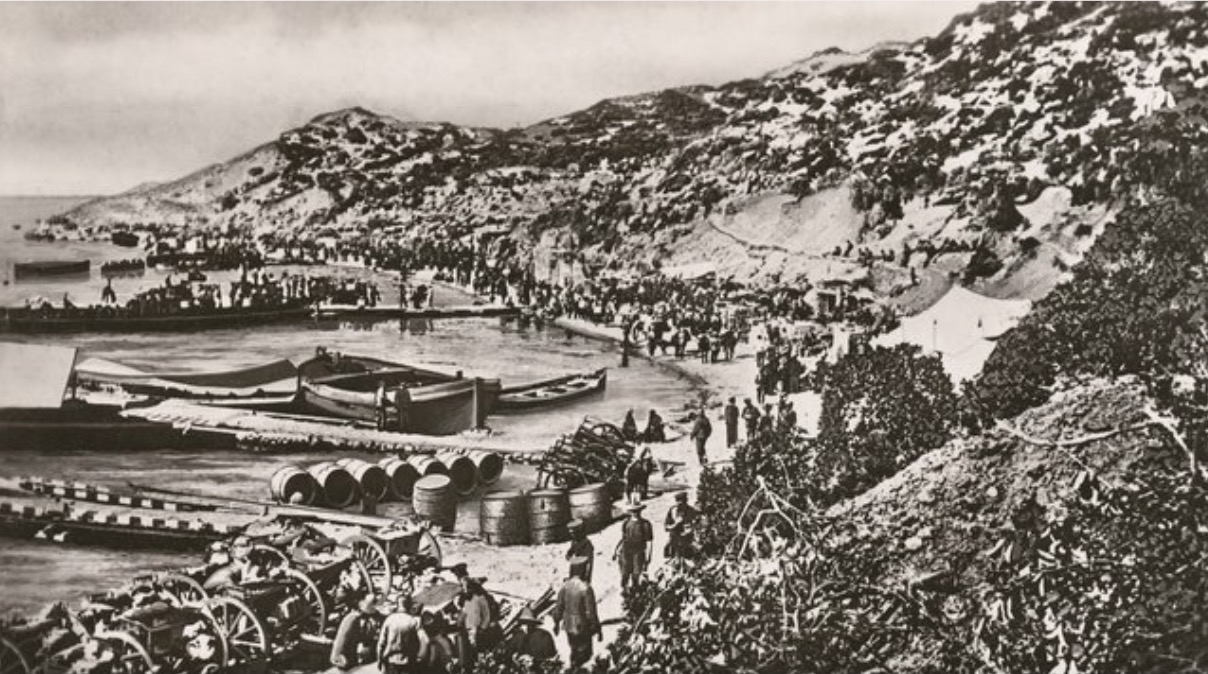
Anzac Cove, Gallipoli.
Monte Video Camp
Nov 24th 1915
Dear Mother,
This view of Anzac Cove as far as I can judge must have been taken about the end of May. The pier which was there when I left is not in the view. The hospital can be seen on the right centre of the view but when I left it was shifted further along and now is in the centre of the cove and would be shown exactly in the centre of the view. Many were the lads who went out in the landing on this spot I first set foot, away along towards the left of the view on the first Sunday Apr 25th there were about 1800 wounded on the spot shown and the scene was a terrible one. The view is not a very clear one the hills are really more steep than they look in the view.
Using the postcard, describe the challenges experienced by Anzac troops attempting to land at Anzac Cove.
The Turkish troops were in trenches at the top of steep cliffs, mowing down ANZACs as soon as they stepped foot on the shore.
Source Analysis Worksheet
-
According to Source 1, what does 25 April 2015 commemorate?
April 25, 2015 marks 100 years since the first landing of ANZAC troops at the Gallipoli Peninsula during World War I. -
Who was the likely audience for Source 1, and what was its main purpose?
The audience for Source 1 was likely US legal scholars and historians, as it was a blog post written for the Law Library of Congress. -
According to Source 2, what were the three main Allied objectives in the Dardanelles campaign?
The aim of the Dardanelles campaign was:
“[1.] Force the empire’s surrender
[2.] Open a route behind the German lines
[3.] Bolster ailing ally Russia” -
How useful is Source 2 for explaining why the Gallipoli campaign failed?
It is moderately useful, as it explains why decision made at the top of the Allied command were not effective, but does not comment on the ways in which it was not carried out correctly. It mentions that “the entire operation lacked unity of effort from the top down,” but fails to explain the inconsistent ways it was carried out, from not detecting mines correctly and ending fire on the Turks too early. -
According to Source 3, what conditions did the men of the 10th Division face when they first went into action?
The men of the 10th Division faced running up a beach with no cover, “heavy shrapnel and machine-gun fire” and no guns to shoot back with. They also had “never heard a shot fired” -
How reliable is Source 3 as evidence about the first combat experience of the 10th Division?
The source is a summarisation of a first-hand account from only one perspective of the battle, so it should be treated with caution, and the book’s contents itself should be used instead if possible as they are first hand experiences. -
According to Source 4, what worried Hamilton as he planned the August offensive?
Hamilton was worried that the Turks would “get wind of our plan” if he told even the corp-commanders, as the news would filter down and possibly get leaked. -
What does Source 4 suggest about Hamilton’s motive for keeping details from some commanders?
Hamilton was worried that if he told the commanders then “news [would] filter down to the juniors” and “Thence to the Turks is but a step.” So if he could keep the plan secret until the last moment it would be less likely to make it to the Turks. -
According to Source 5, how did the name “Anzac” begin?
Anzac started as a code name for the Australian and New Zealand Army Corps which Lieutenant‑General Sir William Birdwood was commanding, then it was used as the “name for the beach where we had made good our first precarious footing”. -
Why did the evacuation make The Anzac Book more valuable to those connected with it, according to Source 5?
It was a recoding of their experiences at Galipoli and while it “was to have been a mere pastime”, it became “a hundred times more precious as a souvenir”. -
How useful is Source 5 for studying the evacuation of Gallipoli?
Source 5 mainly focuses on the praise and legacy of the evacuation, more than how it was carried out. In extracts D and E, it mainly praises the soldiers for their bravery and congratulates them on their successful evacuation. -
According to Source 6, why were some New Zealand soldiers disappointed when they were told to disembark in Egypt?
NZ soldiers were on their way to France when they were told they would disembark in Egypt instead, and they were disappointed “that anything should occur to defer, for even a few weeks, our landing in France.” -
What happened during the attack at The Nek in Source 6?
Australian soldiers were “met by a storm of rifle and machine-gun fire which mowed them down” and “A second line followed and.. a third line was sent forward… but only a few survivors ever struggled back… The ground in front of the Turkish trenches was literally heaped with dead.” -
Who was the likely audience for Source 6, and how might that have affected its presentation of events?
Likely most of the audience would be New Zealanders as it was written as part of “New Zealand’s official popular history of the Great War effort”.
Button orange