Generals
Erich Ludendorff - German General
Ferdinand Foch - French General
Douglas Haig - British General
Expectation of WWI
- A short and decisive war
- All other wars before then had been conducted with short spurts of decisive victories
New technologies laid the groundwork for the power to be in the hands of the defense (“Weapons of War - Machine Guns”)
War
1914
Plans
Germany planned to use the Schlieffen Plan to support a war on two fronts, but by the time war rolled around 10+ years after it was made, it was outdated and was modified. Germany was advancing well, until they pulled some troops to attack Russia, then the Western Front becomes a stalemate.
The French had Plan 17, which dictated they march through Belgium to get to Germany, but they didn’t want to threaten Belgium’s neutrality, so they went to the Western Front instead.
The Race to the Sea
The French and British were racing to get to the sea to stop the Germans from hooking around the back of France.
1915
Static Warfare
The Germans entrenched themselves on the Western Front at the end of 1914 and the Allies created temporary trenches. Troops were still using old tactics against new technologies, going over the top of trenches in a slow march, killed basically instantly.
Easterners vs Westerners
The Debate
- After the stalemate of late 1914 and early 1915, allied commanders began to become divided over which theatre of war would win the war
- Westerners
- Believed that a breakthrough could be made on the Western Front
- Easterners
- Believed that the allies should invade through the “Soft Underbelly” of Southern Europe
Life in the Trenches
“Trench Cycle”
- Two weeks on the front lines
- One week in support lines
- Two weeks in reserve
- One week of rest
Routine Living
- Went through inspection at dawn
- Mostly for the trench foot infection
- Making repairs and digging fortifications
Death
- Death by Artillery Shells
- Death by a sniper
- Death from battle
- Death from Disease
- Rats fed off of the rotting flesh and the troops supplies
- Lice caused men to itch always and caused Trench Fever
Smell
- Rotting Flesh
- Human Waste
- Smell of Disinfectants
- Smell of battle smoke and poison-gas
A War of New Technology
- Modern artillery and machine guns forced soldiers to seek cover and dig for protection.
- The first battle of Ypres marked the end of open and mobile warfare and created the static war of attrition
- Aircraft as a weapon gained momentum throughout the war. Initially used for aerial spotting, planes were later fitted with machine guns and strafed enemy trenches.
- The Germans first used gas in 1914 that accused violent fits of sneezing. However 1915 the gas became more lethal using chlorine and mustard gas
- Tanks were developed by the British as a mechanical solution to trench warfare. They were first used on the Somme in September 1916. They were capable of crossing barbed wire defences. They became more advanced as the war progressed and were used by both sides.
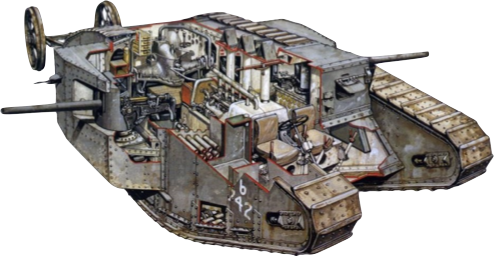
The War of Attrition
- This second year of the war was indecisive and led the commanders to rethink their strategy
- The new German Chief of Staff Erich von Falkenhayn began the war attrition which would force the soldiers to loose heart in their cause; Falkenhayn said of France “Bleed it Dry”
1916
The War of Attrition
Australians at the Western Front
- Australia was involved in 29 battles on the western front.
- Many battles became household names in Australia: Fromelles, the Somme, Bullecourt, Messines, Passchendaele, Villers-Bretonneux, Hamel, Amiens and Mont St Quentin.
- Over 295,000 Australians served on the Western Front between March 1916 and November 1918.
Textbook Notes
Australian forces were transferred to the western front in France in early 1916, where fighting had been in a stalemate since 1914. Apart from the Battle of Verdun (1916) and the 1918 Spring Offensive, the German High Command was content to maintain a defensive position.
The very nature of trench warfare made it constly in terms of casualties to launch a direct frontal attack on the enemy; such attacks usually involved a preliminary bombardment to destroy enemy defences and barbed wire entanglements, followed by soldiers going over the top. Such assaults rarely went to plan and the attacking side often suffered heavy casualties.
Source Analysis 6.9
- Describe the network of British Trenches as seen in Source 6.36
There are multiple lines of trenches with communication lines going between them. - Explain why trenches were not constructed in straight lines.
If trenches were straight, then an enemy who captured one couldn’t just shoot straight down one and kill every soldier at once. - Describe the value of such reconnaissance photographs. What insight does this provide about the role of aircraft in World War I?
These kinds of reconnaissance photographs are useful for providing high level views of land gained and lost between forces. - How useful is Source 6.36 for a historian studying trench warfare?
It’s kind of useful, it’s a single photo that shows men going over the top and one man who’s either dead or having a rest, it’s hard to tell. Overall though, it doesn’t provide much useful information regarding trench warfare. - Do you consider this source reliable? Give reasons to justify your answer.
I would consider this source reliable for the information it can provide, but not what could be inferred from it. It is a primary source, as it was taken at the time, but doesn’t
Button orange