28 June 1914 - Archduke Franz Ferdindand assassinated in Sarajevo
July-August 1914 - European countries mobilise and declare war on each other
29th October 1914 - War Precautions Act is passed (gave the Governor General the power to make regulations for ‘securing the public safety and the defence of the Commonwealth.’)
Sir William Irvine, House of Representatives, 28 October 1914
We all recognise that at a time of ware the Executive is entitled to be invested with authority which Parliament would not think of interesting to it in ordinary times.
November 1914 - The 1st Australian Imperial Force, initially raised in August, is sent to Egypt to train
Late November 1914 - Stalemate on the Western Front
25th April 1915 - Australian and New Zealand (Anzac) forces land on the Gallipoli Peninsula
December 1915 - Allied forces evacuated from the Gallipoli Peninsula
March 1916 - Anzac forces transferred to the western front in France
25th April 1916 - First Anzac Day commemorations held
July to November 1916 - Australian forces take part in the Somme Offensive, particularly the battles of Pozières and Fromelles
28 October 1916 - First conscription referendum held in Australia.
31 October 1917 - The Light Horse charge at Beersheba, Palestine.
20 December 1917 - Second conscription referendum held in Australia.
March 1918 - The German Spring Offensive pushes Allied forces westwards.
April 1918 - Australian forces re-take Villers-Bretonneux, France from the Germans
May 1918 - Major General John Monash is appointed commander of the Australian Corps and promoted to Lieutenant General.
September-October 1918 - Anzac forces contribute to the breaking of the Hindenburg Line.
11 November 1918 - An armistice ends the war at 11am
28 June 1919 - The Treaty of Versailles is signed, formally ending World War I.
1919 - Australian troops begin to return home.
Research Activity
Research and outline the various reasons for Australia’s involvement under the following headings:
- Political
- Strategic
- Cultural
- Personal
Include maps and appropriate graphics in your response.
Political
- The British controlled Australia’s imperial defence and foreign policy.
- Across the political spectrum, war was supported
- Australians believed that Britain was Australia’s primary protector, defending Australia’s trade interests and security, so defending Britain essential for Australia’s survival and prosperity.
Strategic
- Australia’s status within the British Empire meant that when Britain was at war, so was Australia.
- Being Britain’s main force in the Pacific meant that Australia was the primary defender of their home ocean.
Cultural
- Most Australians still viewed themselves as British, as they were members of the British Empire.
- The war was seen as a way to prove Australia as a new nation on the world stage.
Personal
- Going to war was seen as an adventure and an opportunity to prove oneself.
- Going to war was seen as a patriotic duty and if you didn’t go, some people would think you were a coward.
Textbook Questions
Detailed Notes from Page 277
When war broke out Australia had only been a federated country for 13 years. Although Australia was a country, they were still under the dominion of the British Empire, so they were expected to follow their instructions in many areas of government.
Very few Australians had any military experience, so they viewed War as a glorious adventure, exciting and heroic. Around 50,000 men enlisted by the end of 1914 in the Australian Imperial Force.
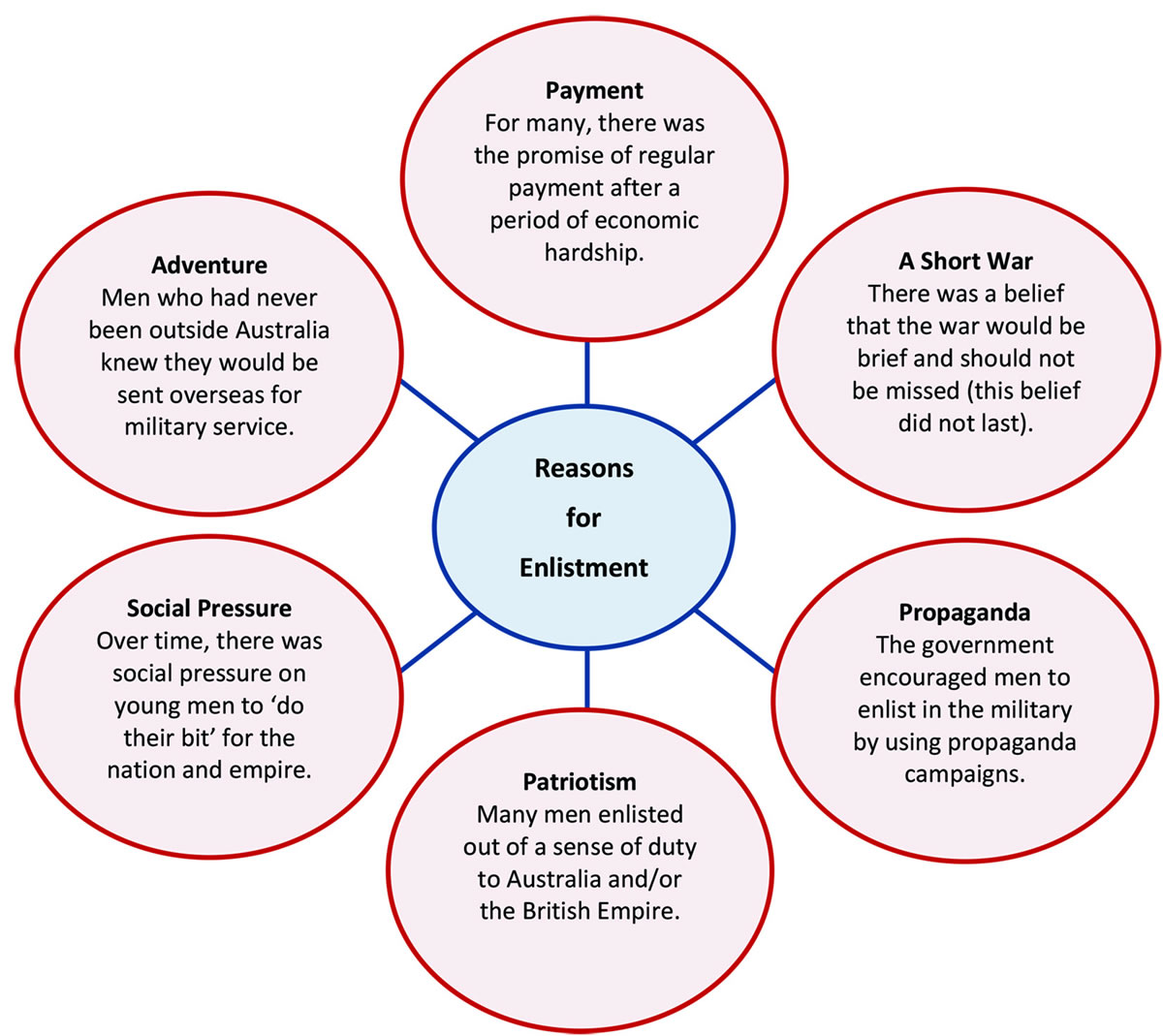
Some men enlisted because they wanted to prove Australia as a new nation, some out of loyalty to the British Empire, some as an adventure, some to earn a good income, and as the war progressed hatred of the enemy boosted enlistments.
Q1. (Interpret) Identify the different motivations and attitudes of the writers.
- Might as well go to war if my friend is
- Duty to country and patriotism
- Pretty good money and an easy job, about to be out of a job anyway
http://historyteacher.net.au/unit1-historical-context.html
Q1. (Review) Describe the attitude of most Australians to war before 1914. Why might they have held this attitude?
Most Australians thought war was either glorious, a necessary duty to be performed, or a good job. They might have had these attitudes because they hadn’t been to war before, and their ancestors had not been to war to hand down stories about it.
Q2. (Review) How many men did Australia initially promise to Britain before the end of 1914? How many had actually enlisted by then?
20,000 men were promised to Britain in August 1914, but 50,000 had enlisted by the end of 1914.
Q3. (Review) Explain the techniques used by the government to encourage men to enlist.
The government encouraged men to enlist by advertising good pay and an adventure. As time went on, the government used anti-German propaganda and tales of German atrocities to encourage men to enlist.
Enlistment
Requirements
The requirements in August 1914 were 19–38 years, height of 5ft 6in and chest measurement of 34 inches. In June 1915 the age range and minimum height requirements were changed to 18–45 years and 5ft 2in, with the minimum height being lowered again to 5ft in April 1917. During the first year of the war approximately 33 percent of all volunteers were rejected.
…
On enlistment recruits were examined for BC or D tattooed on their skin. These were British army tattoos. BC stood for bad character and D for deserter.
Early Reasons
- Patriotism
- Adventure
- Many lived mundane lives involving daily work on a property
- Peer Pressure
- Joining with mates
- Don’t let your mates down
- Women made it clear they like a man in uniform
Late Reasons
- Commitment
- Commitment to those who had already died
- Younger brothers joined up after their older brothers had died to finish the job
- Propoganda
- Women
- Women gave men a white feather if they thought they were fit enough to enlist and hadn’t, to show they were cowards
Ranking
- Adventure
- Peer Pressure
- Patriotism
- Women (White Feather)
- Commitment
- Propoganda
Why?
Most men enlisted for the (1) adventure, a chance to get away from the mundane lives they lived and (2) spend more time with their mates, while (3) defending their country. Others enlisted because they didn’t like being called a coward, wanted to avenge the deaths of others, or they saw enough propaganda to want to join.
Where
- New Guinea
- Took German territory
- October 1914
- Bismarck Archipelago
- Destroyed German Ships SMS Emden
- October 1914
- Galipoli
- ANZAC troops fought against the Turks
- April-December 1915
- Middle East
- Palestine, Egypt, Jerusalem
- France
- Dardanelles
Homework
Find two locations where Australian troops fought in WWI, other than Galipoli.
Find:
- Name
- Area
- Location
- Battalion (if possible)
Pozières, France
| Field | Detail |
|---|---|
| Name | Battle of Pozières |
| Area | The Somme Offensive, Western Front, Northern France |
| Location | The village of Pozières, Somme department, ~6km north-east of Albert, France |
| Battalion/Division | Australian 1st Division (took town on, 23 July 1916) |
| Source | |
| https://www.warhistoryonline.com/instant-articles/pozieres-battle-of-the-somme.html |
Beersheba, Palestine
| Field | Detail |
|---|---|
| Name | Battle of Beershe |
| Area | Sinai and Palestine Campaign, Middle E |
| Location | Beersheba (modern Beer Sheva, Israel), in the Negev De |
| Battalion/Divisio 4th Light Horse Brigade (Australian) - specifically the 4th and 12th Light Horse Regiments ts | |
| Source | |
| https://historyandheritage.cityofparramatta.nsw.gov.au/research-topics/world-war-one/world-war-one-battle-of-beersheba |
Button orange