MAIN
Militarism
Alliances
Imperialsim
Nationalism
or MANIA
Militarism
Alliances
Nationalism
Imperialism
Assassination
Ranked (by me)
- Imperialism
The more land you had, the more people you had and the more you were able to buy and sell and have roaring economy. But this also led to discontent in the conquered countries. - Nationalism
Everyone believed their country was the best, so deserved to be the richest and own the most of the world, hence they made empires and conquered. - Militarism
When everyone saw everyone else was gearing up their military, they felt the need to gear up theirs in case they had to defend themselves. - Alliances
The alliances between European powers made it so that when Austria-Hungary went to war, they had the might of Germany behind them, which meant Britain, France, and Germany had to step in to stop them. - Assassination
The assassination of Arch-Duke Franz Ferdinand made Austria-Hungary go to war with Serbia, starting the war.
INMAA
Militarisation
Definition: Act of assembling and putting into readiness for war or other emergency. Sometimes in response to other countries’ militarisation, or in order to go to war.
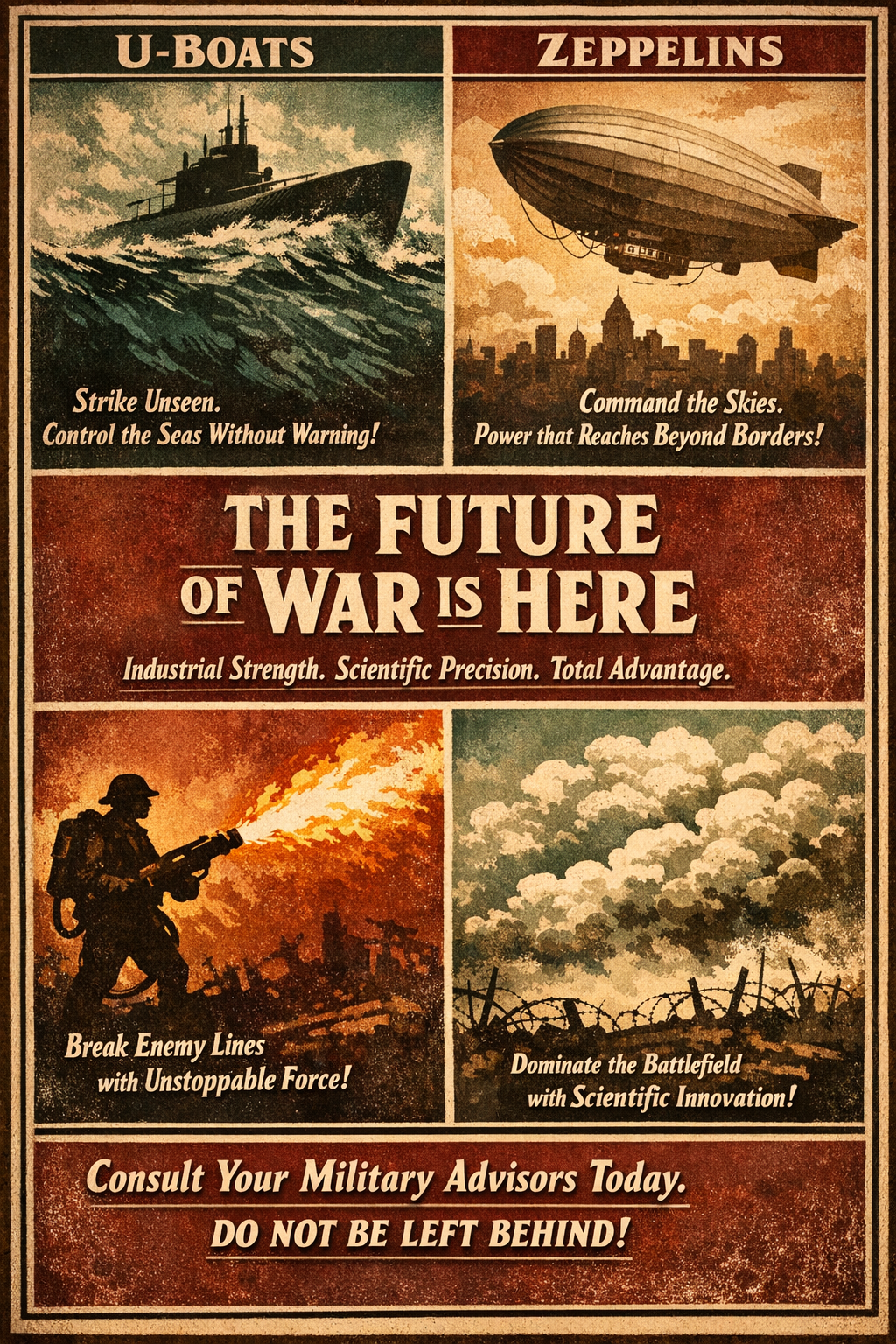
This image was created by AI
Weapons of WWI
The Machine Gun 🔫 🔫
Developed in the 1880s-1890s, machine guns could fire around 600 bullets per minute up to 900 metres, although in initial versions it moved during firing so had to be reaimed after each round. This was fixed in later revisions. Germany quickly developed their own version of the machine gun and made 12,000 of them by the time WWI started.
It took the generals a fair amount of time to adapt to machine guns, as they were still walking slowly in straight lines towards them.
U-Boats 🛥️⬇️🌊
The Germans used under sea boats (submarines) to destroy enemy shipping boats and warships. The destruction of merchant ships is one of the main reasons the US joined WWI. While the first modern submarine was made by an American in 1900, the Germans were the first people to use them in war.
Mustard Gas ⛽️
Fritz Haber was a German chemist who invented mustard gas as a chemical weapon. It caused serious and in some cases deadly burns to enemy soldiers on the eyes, sinuses, and lungs. It often led to permanent or temporary violence a few hours after exposure.
Zeppelins 🎈💣
Zeppelins were used to drop bombs and conduct surveillance during WWI. They were invented by Ferdinand von Zeppelin, a German airship engineer in 1900. They were used to drop bombs in civilian areas to cause psychological damage to civilians.
Flamethrower 🔥🔫
The first modern flamethrower was invented in 1901 and used by the Germans in war in 1915. They had a range of up to 32 metres. The psycholigical impact of flamethrowers was so great that soldiers would sometimes leap into open gunfire to escape flamethrowers.
Rate of Militarisation (1913-1914) 📈
- Britain: High
- Germany: High
- Italy: Moderate
- Russia: Moderate
- Japan: Nil
- USA: Nil
- Austria: Nil
- France: Nil
The two countries that militarised the most were Britain and Germany.
Schlieffen Plan 🇩🇪 🧔🏻
- The Schlieffen Plan was proposed in 1905 by Alfred, Graf (count) von Schlieffen, chief of German general staff, that was designed to allow Germany to was a successful two front war.
- However, by the time Germany did go to war in 1914, the Schlieffen plan was 10 years old, and Count von Schlieffen was dead, so the plan was carried out by his replacement.
- All did not go to plan.
The Initial Plan
- Move a small army to the the Frace-Germany border and a small army to the Russia-Germany border.
- Move a large army up through Belgium and into France.
- Take Paris and loop around to suprise the French at the French-German border.
- Move troops up to attack Russia after this, as Russia would take around 6 weeks to mobilise.
How It Went Down
- Belgium put up a lot more fight than expected, and though they were not able to stop France they did slow them down enough for Britain to join the war and France get warning to increase its troops.
- The Germans left themselves open to attack by the Britons and French by going in front of Paris instead of behind.-
- Russia mobilised quicker than expected, so some troops had to be diverted to hold the border against Russia instead of fighting in France.
Reflection - Many historians and analysts today believed that if the Germans had stuck to their original plan, instead of playing around with it, it might have worked.
The Alliances Before WWI 🤝
Alliances were created to keep a balance of power in Europe, so there was no single dominant power.
1879 - The Dual Alliance 🇩🇪🤝🇦🇹
Germany and Austria-Hungary made an alliance to
- protect themselves from Russia
- prevent the diplomatic isolation of Germany.
1881 - Austro-Serbian Alliance 🇦🇹🤝🇷🇸
Austria-Hungary made an alliance with Serbia to
- stop Russia gaining control of Serbia
- stop Slavic nationalism that was threatening Austria-Hungary.
1882 - The Triple Alliance 🇩🇪🤝🇦🇹🤝🇮🇹
Germany and Austria-Hungary made an alliance with Italy to
- stop Italy from taking sides with Russia
- to counterbalance the power of France and Russia
1894 - Franco-Russian Alliance 🇫🇷🤝🇷🇺
Russia formed an alliance with France to
- protect itself against Germany and Austria-Hungary after the 1882 - The Triple Alliance
- make sure France wasn’t diplomatically isolated.
1904 - Entente Cordiale 🇫🇷🤝🇬🇧
This was an agreement, but not a formal alliance between France and Britain to
- resolve long-standing colonial disputes between Great Britain and France
- counter the rising power of Germany
1907 - Anglo Russian Entente 🇬🇧🤝🇷🇺
An agreement between Britain and Russia to
- resolve colonial disputes in Central Asia and the Middle East
- counter the rising power of Germany
1907 - Triple Entente 🇷🇺🤝🇫🇷🤝🇬🇧
This was made between Russia, France and Britain to
- counter the increasing threat from Germany
- resolve more colonial disputes
1914 - Triple Entente (no seperate peace) 📝
Britain, Russia and France agreed not to sign for peace separately to
- stop themselves from individually concluding peace with Germany, lest Germany then conquer them all one by one and dominate Europe
Imperialism
Imperialism is expanding a country’s power or influence through diplomacy or military force.
Colonies give empires a market, resources and manpower.
Why did empires practise imperialism?
- Get raw materials
- Get new markets to sell goods
- Get a bigger ego and more power
The US acquired many lands in the years after the Civil War, e.g. Alaska and Pacific islands of Midway and Hawaii, Guam, Samoa, Wake, and the Philippines.
Spheres of Influence are sections of a country or region where a nation had special rights and powers.
European Imperialism
Countries in Europe wanted to increase their power, but that meant they had to fight for land amongst themselves because so much of the world was already colonised. That meant they also had to strengthen their own armies to defend themselves, creating an arms race. Countries would also form alliances.
Nationalism
Nationalism means being a strong supporter of the rights and interests of one’s country.
The Congress of Vienna, held after Napoleon’s exile to Elba, aimed to sort out problems in Europe
Delegates from Britain, Austria, Prussia and Russia (the winning allies) decided upon a new Europe
that left both Germany and Italy as divided states. Strong nationalist elements led to the re-
unification of Italy in 186l and Germany in 1871
The settlement at the end of the Franco-Prussian war left France angry at the loss of Alsace-
Lorraine to Germany and keen to regain their lost territory. Large areas of both Austria-Hungary
and Serbia were home to differing nationalist groups, all of whom wanted freedom from the states in which they lived.
Assassination 🔫
On the 28th of June 1914 Archduke Franz Ferdinand, heir to the throne of Austria-Hungary and his wife were attending an official event in Bosnia which had been annexed by AH in 1908, causing resentment among Bosnian Serbs who wished to join Serbia. Members of a Serbian terrorist group shot Ferdinand and his wife were shot by Gavrilo Princip. The assassination was the ultimate excuse for AH to go to war with Serbia.
The July Crisis 🧨
AH sought help from Germany before it attacked, and Germany agreed unconditionally. When Serbia did not agree to a long list of demands that AH gave it, they attacked on the 28th of July 1914. All the nations thought their cause for war was just and that they were fighting in self-defence, and especially that God was on their side. They were swept up by the atmosphere of patriotism and misguided optimism. They believed the war would be over by Christmas. 😔
I had a spare 10 minutes while making notes from pages 151-155 so I added emojis.
Flashpoint Short Term Causes
Morocco Crisis
In 1904 Morocco had been given to France by Britain, but the Moroccans wanted their independence. In 1905, Germany announced her support for Moroccan independence. War was narrowly avoided by a conference which allowed France to retain possession of Morocco. However, in 1911, the Germans were again protesting against French possession of Morocco. Britain supported France and Germany was persuaded to back down for part of French Congo.
Bosnian Crisis
In 1908, Austria-Hungary took over the former Turkish province of Bosnia. This angered Serbians who felt the
province should be theirs. Serbia threatened Austria-Hungary with war, Russia, allied to Serbia, mobilised its
forces. Germany, allied to Austria-Hungary mobilised its forces and prepared to threaten Russia. War was
avoided when Russia backed down. There was, however, war in the Balkans between 1911 and 1912 when the
Balkan states drove Turkey out of the area. The states then fought each other over which area should belong
to which state.Austria-Hungary then intervened and forced Serbia to give up some of its acquisitions. Tension between Serbia and Austria-Hungary was high.
Critical Flashpoint: Assassination
The Archduke actually planned to give Bosnia back to Serbia because they were more trouble than they were worth, but they shot him because they didn’t know that.
Textbook Activities
1. List the five great powers of Europe
- Britain
- France
- Germany
- Russia
- Austria-Hungary
2. Define the term ‘militarisation’ and explain how it created tension between the great powers.
Militarisation is getting ready for war, commonly shown by an arms race or rising hostilities. It created tension between the powers of Europe because as each country’s army got bigger, the other countries felt they had to grow their armies so that they could defend themselves as well.
3. Identify the long term causes of WWI
- Militarisation
- Alliances
- Nationalism
- Imperialism
- (Assassination)
4. Explain the motivations of the Black Hand terrorist group.
The Black Hand terrorist group were a group of Bosnians who wanted to be a part of Serbia again, as Bosnia had previously been annexed by Austria Hungary.
5. Explain why the public’s reaction to the outbreak of war was positive.
After having tensions high for so many years with little wars almost breaking out all the time, everyone was ready for it to end, and because they all thought they were right to defend themselves, and they were sure to win, they could finally lower the tensions by just controlling the whole of Europe themselves.
6. Which of the long- and short-term causes was the most important contributor to the outbreak of war in August 1914?
The assassination of Arch Duke Franz Ferdinand and the alliances between countries was ultimately the main reason that was broke out. The assassination was the catalyst and the alliances between countries ensured that all countries were obliged to help the others in some way, leading to war.
7. To what extent was the system of Alliances responsible for the conflict become a world war?
A fair lot, if Austria Hungary hadn’t allied themselves with Germany and Italy, then Britain, France and Russia mightn’t have felt the need to ally themselves, and then the problem would have just been Austria-Hungary and Serbia, not the entire world.
The Countries in WWI
WWI was very Eurocentric.
The Central Powers
Germany
Austria-Hungary
Ottoman-Turkey
Bulgaria
The Allies
Britain
France
Russia
Belgium
Italy
USA (from 1917)
Serbia, Portugal
Japan
Why did the US join?
The Zimmerman Telegram: Germany sent a coded message to Mexico promising some US states if they didn’t fight against Germany in the war. The US saw this as a threat so they joined the war.
Why did Australians join?
- Employment Opportunities
- The sense of adventure and an opportunity to see the world
- The belief the war would be over by Christmas
- Hatred of the enemy or the Hun
- Social pressure from friends, people who couldn’t go and women.
- Financial incentives
- German control of New Guinea to the North
- Australia is isolated and needs British protection
- Chance to prove ourselves as a new nation
- Member of the British Empire
- Patriotism - in 1914 most Australians were of British descent
Textbook Notes
Australia was automatically at war when Britain declared war on Germany because it was a loyal member of the British Empire.
The popular reaction to the war was enthusiasm, as most Australians thought of themselves as members of the British Empire, reinforced by the education system and the Church. There was also enforced military children for boys over the age of 12. Propoganda encouraged young men to enlist by emphasis Australia’s links to the Mother Country, promoting war as heroic and glorious.
By the end of 1914 over 52,000 men had voluntarily enlisted into the Australian Imperial Force. By the end of the war, 416,908 had enlisted in the AIF, and of those, 334,000 served overseas. With plenty of potential troops at the start there were strict physical requirements for the first men, which were relaxed as the war dragged on.
Source analysis 6.2
Australians will stand beside [the mother country] to help and defend her to our last man and our last shilling
OLAF
When the Empire is at war, so is Australia at war. All our resources are in the Empire and for the preservation and security of the Empire.
PMJC
- Explain what you think Opposition Leader Andrew Fisher meant by ‘defend her to our last man and our last shilling’.
Australia would stand with the British Empire until all of us had died, or they had died. - What statement did Prime Minister Joseph Cook make in response to Germany’s declaration of war on France?
The one in the quote? - Compare Cook’s response to Fisher’s statement. How were they similar?
They both say that Australia needs to stand with the empire, although Cook is less patriotic and more acknowledging that Australia needs the British Empire to stay alive. - Why might these sources be useful to a historian studying the reasons for Australia’s involvement in WWI?
They would be able to understand and compare sentiments from both political parties in Australia at the time of the war.
Source Analysis 6.3
- Identify the year with the highest number of enlistments.
1915 - Provide possible reasons for the decline in enlistments after 1915.
People realised the war wouldn’t be over before Christmas, that people were dying in war, and that it was not fun.
Source Analysis 6.4
- Identify the main message of the recruitment poster in Sources 6.13.
Australia’s doing great in the war! Keep it up and enlist! - Identify which millitary campaighn you think this poster relates to. Explain your answer.
I have no clue. I know next-to-nothing about WWI. - How does the message of the poster in Source 6.14 compare or contrast with the message in source 6.13?
Source 6.14 reminds Australians of the losses at the Battle of Fromelies and tugs at the heartstrings a bit, going “why weren’t you there, helping defend your fellow Australians?”
Button orange