Car Safety
Car safety is influenced by factors inside the car and outside the car.
Inside the car:
- Safety features
- Airbags (most vehicles don’t have side air-bags even though it makes crashes safer)
- Crumple zones
- Competence of and how safe the driver is
Outside the car: - Weather conditions
- Fog
- Rain
- Road conditions
- Flooded or slippery road
- Broken or cracked road
Reaction Time, Braking Distance and Stopping Distance
Reaction Distance: Reaction distance is the distance you travel between detecting a hazard and responding to it.
Braking Distance: Braking distance is the distance you travel between starting to brake and coming to a complete stop.
Stopping Distance: Stopping distance is the sum of the reaction distance and braking distance.
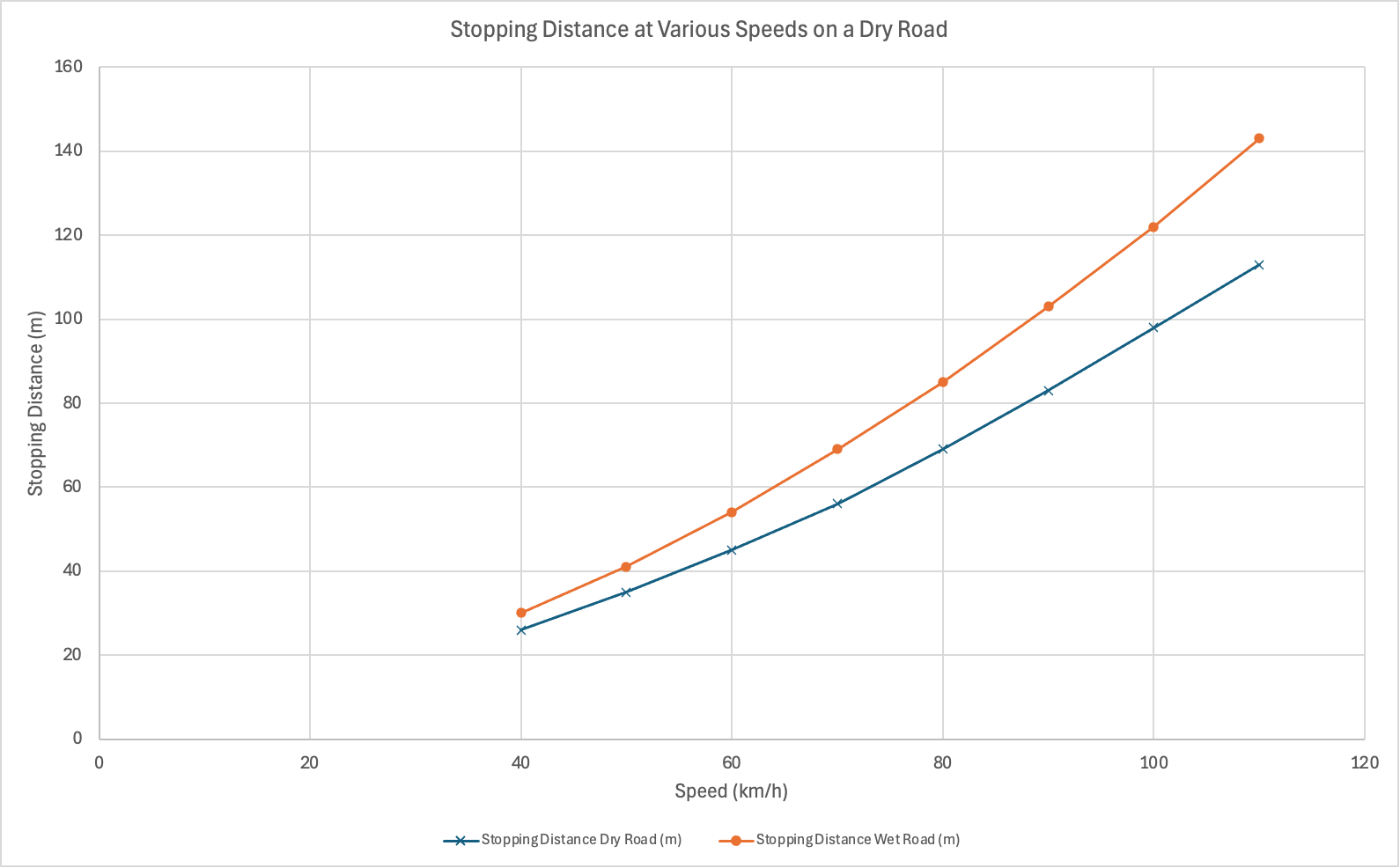
Use secondary data to determine the braking distance for a car travelling at various speeds
Stopping Distance at Various Speeds.xlsx
Explain how braking distance and reaction time affect car safety
Having a longer reaction time increases the time it takes to fully stop a car (stopping distance). Reaction time is increased by distractions, such as mobile phones or the radio. Another contributing factor to stopping distance is braking distance, how far a car needs to travel to come to a complete stop. Braking distance is also affected by the speed the car is travelling at and the road conditions; a higher speed and/or wetter or slipperier road increase braking distance.
The sum of reaction time and braking distance create stopping distance, the total distance between when a driver sees a hazard and is able to come to a complete stop. As stopping distance increases, so does the likelihood of a crash. A slow reaction time or high speed both increase stopping distance, increasing the likelihood of a crash, lowering car safety.
Determine reaction time given a method and some data
See 10 Science Red 2026 OneNote
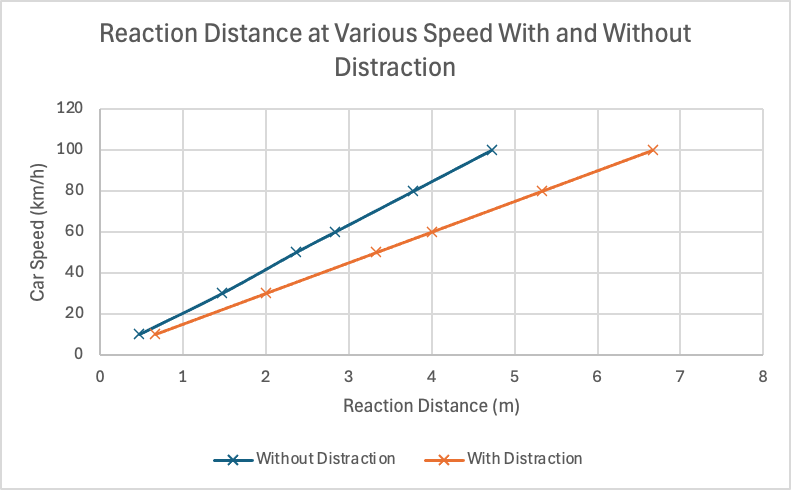
Reaction [time] is the [time] you [take] between detecting a hazard and responding to it.
10 Science Red 2026 OneNote
As speed increases, reaction distance increases
We did a prac where you drop a ruler and have to try and catch it as quickly as possible with your foot, then see how far the ruler fell.
Define distance, displacement, speed, velocity and their units
Distance: A scalar measurement. Total length of the path taken between the starting and finishing point of a journey (m)
Displacement: A vector measurement. Indicates the location of the destination relative to the journey’s starting location, irrespective of the path actually taken between the two points (m + direction (north/south/east/west/angle))
Speed: A scalar measurement. Distance travelled per unit of time (m/s-1)
Velocity: A vector measurement. Displacement (s) per unit of time (t)
Solve simple problems involving distance, displacement, speed, velocity
Problem 1: An object moves from point A to point B to point C, then back to point B and then to point C along the line shown in the figure below.
a) Find the distance covered by the moving object.
The object moves 17km (9+4+4=17).
b) Find the magnitude and direction of the displacement of the object.
The object experiences a displacement of 9km east.
Problem 2: A plane carrying passengers from Melbourne to Perth flies at an average speed of 250ms-1. The flight takes 3.0 hours. Use this information to determine the approximate distance by air between Melbourne and Perth.
Speed = 250m/s
Time = 3 hours
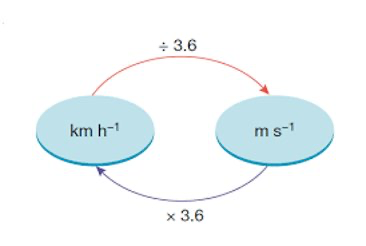
250m/s*3.6 = 900km/h
900*3=2700km
Bonus: Vector vs Scalar
Vector: A measurement that includes magnitude and direction. In physics, they are drawn as arrows: the length shows the magnitude and the direction show direction.
Scalar: A measurement that includes magnitude and no direction
Bonus: Converting between units of speed