Crash Course
A second crash course
A third Crash Course
Name simple ionic and covalent compounds, given the formulas
Ionic
To name an ionic compound.
- Figure out which goes first, usually the element further left on the table
- The first element’s name stays the same, the second’s end is replaced with ‘ide’.
If there are three or four elements, it will end in an ite; If there is more oxygen, it will be an ‘ate’.
E.g. sodium sulfate and sodium sulfite contain sodium, sulfur and oxygen. Sodium sulfate contains more oxygen than sodim sulfite.
Iconic Practise
-> Magnesium Sulfide
-> Lithium Nitride
-> Potassium Hydride
Covalent
To name an covalent compound
- Place the elements in their proper order.
- The element farthest to the left in the periodic table is usually named first. If both elements are in the same group, the element closer to the bottom of the column is named first. is named hydrogen chloride (because hydrogen is to the left of chlorine in the periodic table), and is phosphorus pentachloride. The order of the elements in the name of , bromine trifluoride, is determined by the fact that bromine lies below fluorine
- The second element is named as if it were a monatomic anion in an ionic compound (even though it is not), with the suffix -ide attached to the root of the element name.
- Identify the number of each type of atom present.
- Prefixes derived from Greek stems are used to indicate the number of each type of atom in the formula unit
| Prefix | Number |
|---|---|
| mono- | 1 |
| di- | 2 |
| tri- | 3 |
| tetra- | 4 |
| penta- | 5 |
| hexa- | 6 |
| hepta- | 7 |
| octa- | 8 |
| nona- | 9 |
| deca- | 10 |
-
- If a molecule contains more than one atom of both elements, then prefixes are used for both. Thus is dinitrogen trioxide.
- In some names, the final a or o of the prefix is dropped to avoid awkward pronunciation. Thus is osmium tetroxide rather than osmium tetraoxide.
- Write the name of the compound.
- Binary compounds of the elements with oxygen are generally named as “element oxide,” with prefixes that indicate the number of atoms of each element per formula unit. For example, is carbon monoxide. The only exception is binary compounds of oxygen with fluorine, which are named as oxygen fluorides.
Covalent Practise
-> sulfur dioxide
-> sulfur hexafluoride
-> dinitrogen tetroxide
-> chlorine dioxide
-> ammonia
-> water
Describe the difference between ionic and covalent compounds
| Feature | Ionic compounds | Covalent compounds |
|---|---|---|
| Elements involved | A metal and a non-metal | Two non-metals |
| Diagram | 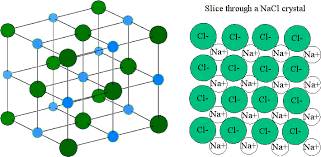 | 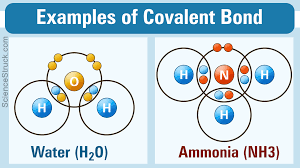 |
| What happens to electrons | Electrons are transferred, so atoms become charged ions. Metals form positive cations and non-metals form negative anions. | Atoms share pairs of electrons so both can achieve a full outer shell. |
| Bonding | Oppositely charged ions are held together by electrostatic attraction (an ionic bond). | Shared electron pairs form covalent bonds. A single bond has one shared pair; a double bond has two shared pairs. |
| Structure | A crystalline lattice of positive and negative ions in an orderly arrangement; not discrete molecules. | Discrete molecules. |
| What the formula shows | The ratio of ions, e.g. , . | The type and number of atoms in one molecule, e.g. water and carbon dioxide. |
Write balanced chemical formulas for simple ionic and covalent compounds
Rules for Ionic Compounds
- Write down the element symbols
- Write the VALENCY of the element above it
- Cross it down
- Leave out the 1’s
- If the numbers are the same, they cancel
- Polyatomic ions - Do NOT put two little numbers together – use brackets! E.g NOT .
Examples
sodium chloride ->
lead(II) chloride ->
aluminium nitride ->
magnesium sulfide ->
sodium sulfate ->
aluminium carbonate ->
aluminium chloride ->
magnesium hydroxide ->
Rules for Covalent Compounds
- There are no charges involved with covalent compounds.
- Interpret the prefixes to represent the number of atoms or the subscript.
- Do not cross or reduce subscripts (unlike ionic compounds).
- The formula should reflect the name of the compound.
Examples
dinitrogen monoxide ->
carbon monoxide ->
carbon tetrachloride ->
sulfur hexafluoride ->
Button blue