The Stolen Generations
Indigenous children removed from their families and put in institutions or foster families throughout the 20th century. These children were usually be forbidden to speak their language, to see their families, or engage in any indigenous cultural rites.
Removing children from their families not only retrains the children to act according to the new culture, but breaks the communities and families they were taken from.
Assimilation: When a minority culture merges into a dominant culture with the minority being required to leave its own culture behind.
Integration: A society where people of different cultures live together and interact with each other allowing a peaceful coexistence.
Short Discussion Questions
What reasons were given for taking Aboriginal children from their families and communities?
- To educate them
- To improve their health
- To advance them
What was the long-term aim of this practise? - To destroy their culture
What was its impact? - It has damaged culture
- It has limited social contact
- It has limited language
- It has created a loss of religion
Were parents involved in deciding their children’s future?
No.
What were children ‘educated for’? In your answer, specify boys’ and girls’ roles. - To be jackaroos
- To be maids
Why was contact with parents and others of Aboriginal descent limited?
Likely because the Australian Government believed that should they be able to contact their families, they would not learn to accept the ‘white’ culture and way of life.
Many Aboriginal children who had been stolen were unable to be reunited with their families and communities. Why was this the case? What problems could this cause?
Because they did not know where their families were or where they lived. This
Do you believe the policies were truly for the children’s ‘best interests’?
No.
Why do we refer to the ‘stolen generations’ and not just ‘stolen children’?
It impacts multiple generations of indigenous people, not just the children.
The policy of assimilation failed - why do you think this happened?
Why did they think it would work in the first place?
Textbook Work
Notes
During the celebration of the bicentenary, Prime Minister Bob Hawk proposed a Council for Reconciliation between ATSI peoples and the wider Australian community. It was formed in 1991 and sought to bring justice and equity for all.
In 1996 the government launched an official investigation into the Stolen Generations, compiled into the Bringing them Home report, 680 pages of 777 individuals and revealed the misery of the ATSI peoples because of Assimilation. A new ten-year process of reconciliation begun in 2001 built on
- Acknowledging the traditional owners of the land
- The 1967 referendum
- Native title
- Contributions made to Australia by Aboriginal and Torres Strait Islander peoples.
Prime Minister John Howard refused to apologise, but expressed regret at what the ATSI peoples had experienced. Annual National Sorry Day was established in 1998. The ‘Sorry Day March’ was an event when 250 000 people marched across Sydney Harbour Bridge on 26 March 2000. Michael Long, an Aboriginal Activist and ex-AFL player undertook the Long Walk from Melbourne to Canberra to raise awareness of ATSI issues before meeting with then Prime Minister John Howard.
Finally, on 13 February 2008, the Labor Prime Minister Kevin Rudd delivered a formal apology to the ATSI peoples from the federal government for their part in the Stolen Generations.
Questions
Source Question
Source 8.34 An Aboriginal elder from Sydney, Nancy Hill-Wood, holds up a sign before the Apology to the Stolen Generations delivered by Prime Minister Kevin Rudd in Canberra in 2008.
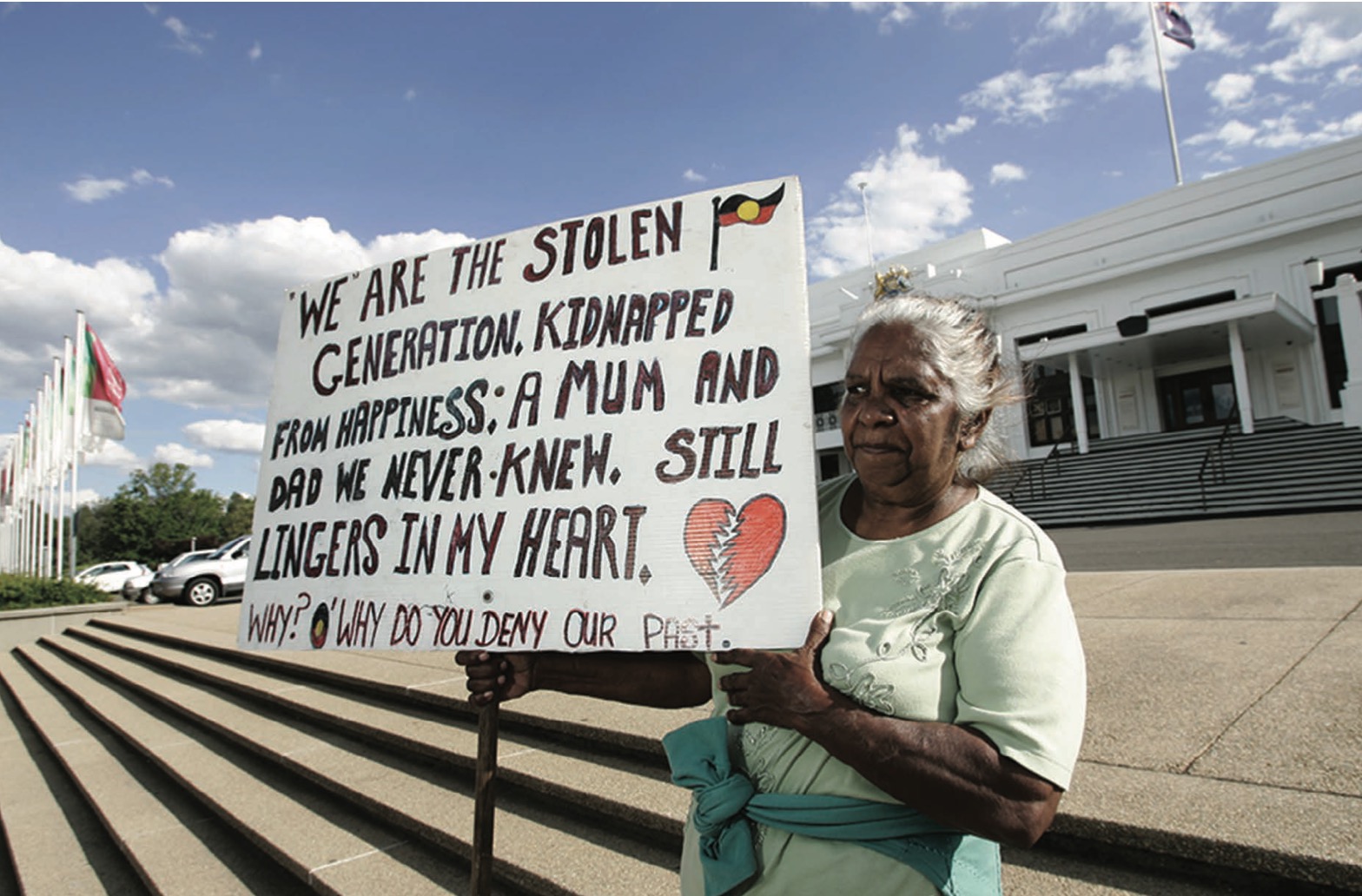
- Based on the wording of the sign, describe the probable background of the woman holding it.
She is almost certainly a woman who was taken as part of the Stolen Generations. - Why do you think she felt the apology was important enough for her travel from Sydney to Canberra?
Because she had likely lived her whole life knowing that she was Aboriginal but not being allowed to talk about it or take part in her culture. Additionally, she was not allowed to interact with or even know who her mother and father were. This is definitely a good enough reason for anyone to ask for an apology. - From the video, identify the actions for which Prime Minister Kevin Rudd is saying sorry.
The federal government enacting the multiple policies designed to remove Aboriginal peoples’ culture and make them more ‘Australian’. These policies created profound grief, suffering and loss and Prime Minister Kevin Rudd apologised for it. - What does Prime Minister Rudd hope for the future?
A better future where ATSI people and all of Australia can live in harmony and equity.
Activity 8.8
Using the information from Section 8.5 of this chapter and your own research, complete the following questions.
- Create a timeline of the events in this section.
| Year / Date | Event |
|---|---|
| 1988 | During Australia’s Bicentenary celebrations, Prime Minister Bob Hawke proposed a Council for Aboriginal Reconciliation. |
| 1991 | The Council for Aboriginal Reconciliation was established to promote justice, equity, and improved relationships between Aboriginal and Torres Strait Islander peoples and the wider Australian community. |
| 1995–1997 | The federal government held a national inquiry into the Stolen Generations. Its findings were published in the Bringing Them Home report in 1997, documenting the effects of forced removal and assimilation policies. |
| 1998 | The first National Sorry Day was held, recognising the suffering caused to Stolen Generations survivors and their families. |
| 26 May 1998 | Prime Minister John Howard expressed regret for past treatment of Aboriginal and Torres Strait Islander peoples, but refused to make a formal national apology. |
| 26 March 2000 | About 250,000 people took part in the Sorry Day March, walking across Sydney Harbour Bridge in support of reconciliation. |
| 2000 | Former AFL player and Aboriginal activist Michael Long began The Long Walk from Melbourne to Canberra to raise awareness of Aboriginal and Torres Strait Islander issues. He later met with John Howard. |
| 2001 | The formal ten-year reconciliation process concluded. It focused on recognising Traditional Owners, the 1967 Referendum, Native Title, and Aboriginal and Torres Strait Islander contributions to Australia. |
| 13 February 2008 | Labor Prime Minister Kevin Rudd delivered a formal federal parliamentary apology to Aboriginal and Torres Strait Islander peoples, especially the Stolen Generations. |
- Explain how the legislation changes of 1962, 1967 and 1993 affected Aboriginal and Torres Strait Islander peoples.
From 1962 onwards, Aboriginal and Torres Strait Islander peoples were allowed to vote in federal elections. From 1967 onwards, Aboriginal and Torres Strait Islander peoples were counted in the census and Indigenous affairs were no longer carried out by the states, but managed by the federal government. In 1993, the Native Title Act allowed Aboriginal and Torres Strait Islander peoples to claim ownership of their traditional lands and waters. - Evaluate the significance of Aboriginal-led activism in bringing about these changes.
Aboriginal led activism was a key part of bringing about the changes that resulted in reconciliation; from the Day of Mourning to the Australian Freedom Rides, they played a key part in bringing about the necessary change. - Account for the factors that contributed to the rise of the reconciliation movement. Present your answers in a written or audio-visual format.
The Royal Commission into Aboriginal Deaths in Custody in 1991 was the immediate catalyst for the formal process, highlighting deep, systematic disadvantages and recommended that the federal government start a reconciliation process.
The High Court’s Mabo decision in 1992 overturned the myth that Australia was terra nullius when it was colonised, leading to the Native Title Act in 1993.
In December 1992, Prime Minister Paul Keating formally acknowledged the historic dispossession, systemic violence, and forced removal of First Nations children by the government.
In 1997, the Bringing Them Home report exposed the devastating intergenerational trauma caused by the Stolen Generations and shocked the wider Australian community into action, including the 2000 Corroboree bridge walks, where 250,000 people walked the Sydney Harbour Bridge in support of reconciliation.
Mount Annan Site Study
Questions
- Why do you think the memorial was built before the official apology issued by the federal government?
Because the memorial was not designed to be an official apology, but rather a public acknowledgement of the horror and grief caused by the Stolen Generations. - Identify how the legacy of the Stolen Generations has been represented in the form of a memorial.
Source 8.37 shows how families were broken up and source 8.38 shows how children were taken away and returned on a journey of healing to their families as adults. - Account for the repeated use of the word ‘peace’ or ‘peacefulness’ in the official statements created by the Royal Botanic Gardens.
The Sculpture not only demonstrates the pain and suffering that was caused, but also the journey to peace and peacefulness that can be brought by reconciliation. - Explain the body language of the figures depicted in the sculpture.
The figures are depicted as scared, in fear of having their family driven apart. The child is holding onto his father in desperation and fear and there is a boundary separating the mother and father. - Explain why it is important that those involved in the construction of this memorial were Aboriginal and/or Torres Strait Islander people.
Because they understand the pain and suffering caused by the Stolen Generations and how to represent it in a way that people will understand.
Yirrkala Bark Petition
Completed by NB, JAG and AM
Aims
Since the late 1950s, the Australian Federal Government had been granting mining rights to a series of private companies. When the Yolngu people learnt of this, they wrote a series of 4 petitions to protest these mining rights arguing that the Yolngu people owned the land that the mining rights were granted for, and were trying to end mining in Yolngu land.
Methods
The petition was typed in both English and traditional Yolngu Matha text then glued or framed by large rectangular sheets of stringybark. Senior Yolngu artists also painted traditional Madayin clan designs in natural ochre, charcoal, and pipeclay around the borders of the bark. The petition had handwritten signatures and/or thumbprints by community leaders. The first petition had nine signatures/thumbprints and the second had thirty one. This petition was brought before The House of Representatives and rejected, then brought back with more signatures and accepted.
Achievements
The Yirrkala Bark Petition paved the way for important future victories to occur. This included the 1967 Referendum and the 1992 Mabo decision that overturned terra nullius. The petition became the first traditional document recognised by the Australian Parliament, making it a major milestone for First Nations People and their rights being recognised. Today, the Yirrkala Bark Petition continues to influence modern battles concerning historical land acquisitions on traditional country.
Button orange