Policies
| Policy | Key Date | Main Idea | Adoption/variation |
|---|---|---|---|
| Protection | From the 1800s | Governments controlled where Aboriginal people lived, worked and moved-Protection Boards managed wages, reserves and children. | NSW appointed a Protector in 1881 and established the Aborigines Protection board in 1883, the NSW Aborigines Protection Act was passed in 1909 and abolished in 1969. |
| Assimilation | 1937 | The Government “suggested” that Aboriginal people people should eventually “attain the same manner of living as other Australians and to live as members of a single Australian community enjoying the same rights and privileges, accepting the same responsibilities, observing the same customs and influenced by the same beliefs, hopes and loyalties as other Australians” | While the federal government policy of assimilation makes its intents sound benevolent, the way it was carried out in most states was far from it. Under the Child Welfare Act 1939 and other amendments, The Stolen Generations took place. Additionally, the Aborigines Protection Board was renamed the Aborigines Welfare Board in 1940 and shifted to focusing on assimilation. The government also tried to break up reserves and missions to force Aboriginal people to move to mainstream towns. |
| Integration | 1965 | The government had realised their earlier assimilation policies failed, leading them to take a separate approach, where ASTI peoples were given the choice to assimilate instead of forced, with the original goal of assimilation still standing. | The NSW government completely abolished the NSW Aborigines Welfare Board under the 1969 Aborigines Act. This moved Aboriginal Children to the mainstream child welfare system, where they could no longer be taken from their homes without evidence of neglect and a court order. This change dismantled the ideas of assimilation and the erasure of Indigenous culture, allowing their traditions to exist within Australian life. Whilst Aboriginal children could still be taken away, it could not be due to the erasure of Indigenous Culture. |
| Self-determination | 1972 | Aboriginal and Torres Strait Islanders can control their own cultural preservation and social structures. This allows them to be proud and control their cultural heritage while still being part of the Australian Nation State | Many government policies such as those below enacted the policy of self-determination, from the 1970’s to the modern day - Aboriginal Land Rights Act (Northern Territory) 1976 - Aboriginal Councils and Associations Act 1976 - Corporations (Aboriginal and Torres Strait Islander) Act 2006 |
Textbook Work
Source 8.13 Roughsey, E., 1984, An Aboriginal Mother Tells of the Old and the New, Penguin Books
I can remember when I was young, I saw lots of girls, older ones, also boys being flogged with a piece of motor car tyre, saw blood streaming from their bottoms and legs where they’d been cut as they were flogged. They were cruelly treated and for days they would have these wounds with red sores. The missionaries did not care to cure or deal with the bruises and cuts. It healed by itself.
Source 8.14 Confidential evidence 170, Queensland, 'Bringing Them Home' report, 1997
Y’know, I can remember we used to just talk lingo. [In the Home] they used to tell us not to talk that language, that it’s devil’s language. And they’d wash our mouths with soap. We sorta had to sit down with Bible language all the time. So it sorta wiped out all our language that we knew.
Source 8.15 Confidential evidence 10, Queensland, 'Bringing Them Home' report, 1997
I remember once, I must have been 8 or 9, and I was locked in the old morgue. The adults who worked there would tell us of the things that happened in there, so you can imagine what I went through. I screamed all night, but no one came to get me.
Source 8.16 Peter Read, The Stolen Generations: The Removal of Aboriginal Children in New South Wales 1883-1969, Occasional Paper (No.1), New South Wales Ministry of Aboriginal Affairs, Sydney, 1990
… some managers cut a long story short when they came to part of the committal notice, ‘Reason for the Board taking control of the child’. They simply wrote, ‘For being Aboriginal’.
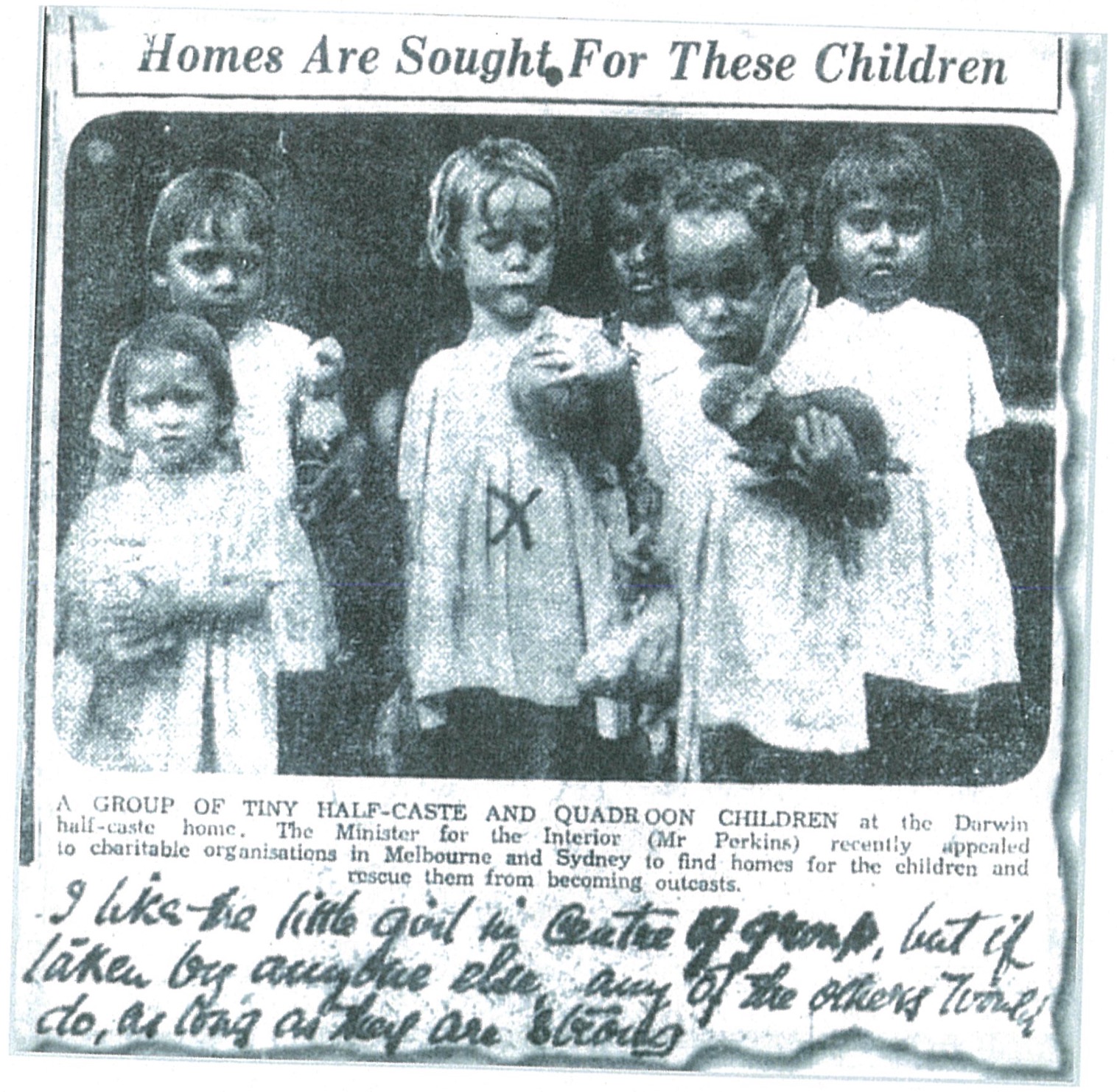
Source 8.17
An Alice Springs Newspaper clipping advertising re-educated children for adoption, 1934, with notes from a white Australian responding to the advertisement. The handwritten note at the bottom of the article reads, ‘I like the little girl in centre of group, but if taken by anyone else, any of the others would do, as long as they are strong.’
- In Source 8.13, identify the elements of the author’s recount that are factual and those that are opinion.
Fact:- Girls and boys were “being flogged with a piece of motor car tyre”.
- Blood was “streaming from their bottoms and legs where they’d been cut as they were flogged”
- “The missionaries did not care to cure or deal with the bruises and cuts. It healed by itself.”
Opinion: - “They were cruelly treated” (for reference I also believe they were cruelly treated)
- Discuss in what way Source 8.14 is useful for a historian studying white Australian attitudes towards Aboriginal and Torres Strait Islander peoples culture.
It allows the historian to understand for a first-hand account what white people in their Mission thought of Aboriginal culture. Namely that they though their language was “the devil’s language” and how they were punished and their language and culture was removed. However, it does come from a biased source, since they were the victims of the treatment. - Compare Sources 8.13, 8.14 and 8.15 and describe similarities and differences with the experiences of the Stolen Generations.
The sources all similarly show treatment of Aboriginal and Torres Strait Islander peoples to be cruel and often inhumane in an attempt to remove their culture. While in Source 8.13 the punishment is physical and painful, in Source 8.14, the punishment is uncomfortable but not painful and in Source 8.15, the punishment is simply neglect, intentional or not. - Analyse what Source 8.16 reveals about the difficulty of examining primary sources from the government perspective.
Source 8.16 shows that government records can be brief, impersonal and incomplete. The committal notices recorded the official reason for taking a child as simply “For being Aboriginal”, but do not explain the child’s circumstances, the family’s view or the effects of removal. This makes it difficult for historians to know whether the records show the full policy, the views of individual managers, or how the policy was experienced. Historians therefore need to compare government documents with oral testimony and other evidence. - Discuss the purpose of Source 8.17 and what this reveals about an alternative perspective of the Stolen Generations.
The newspaper makes it seem as if these children are simply in need of a loving home, or that they have no parents to look after them. So it appears to the reader that, should they adopt a child, they are looking after them as their own child.
However, the handwritten note at the bottom would imply that the writer did not want the child in order to love them or look after them, but simply to get a child, any child, probably to do some sort of labour. - After examining all sources, analyse whether the intention of government policy for the Stolen Generations matches up with the reality of what happened.
No, it definitely does not. While the assimilation policy makes it sound as if Aboriginal people will be ‘encouraged’ to be educated into white society, in reality, the actions taken to ensure this outcome were much more violent and coldhearted than set out in the policy.
However, there is a question to be asked of whether what happened was what the government intended, and they simply tried to make it sound kind, when they never intended it to be. - Many of the sources included here are the recollections provided by members of the Stolen Generations. Why might historians value oral testimony like this when they try to research the experiences of this group?
Because it gives a first-hand account of what happened to Aboriginal people part of the Stolen Generations. It provides a perspectives free from the government’s potential tampering or other changes. - Using any two of the sources and other evidence, describe the common experiences of the Stolen Generations.
The Stolen Generations commonly experienced removal from their families and communities, separation from siblings, and attempts to assimilate them into white Australian society. Source 8.14 shows children being forbidden to speak their own language, punished by having their mouths washed with soap, and forced to use “Bible language”. Source 8.15 shows the fear, neglect and lack of care some children experienced in institutions, where an eight- or nine-year-old was locked in a morgue and left screaming overnight. Other evidence, including the Bringing Them Home report, shows that many children also lost contact with family, culture and Country, and that these effects continued into adulthood.
Button orange