World War I officially ended on the 11th November 1918. Initially, the Armistice is declared, so fighting is stopped while a peace treaty is drawn up.
Research Task - The Paris Peace Conference and the Treaty of Versailles
-
Who are the ‘Big Three’ (include a photo) and what was their view in regards to the Treaty?
The ‘Big Three’ were:- Georges Clemenceau (Prime Minister of France)
- Wanted to punish Germany, disband the army and make them pay huge reparations
- Wanted the Alsace-Lorraine region returned to France
- Wanted the Rhineland to be independent to weaken Germany
- Woodrow Wilson (President of the USA)
- Wanted to end the war and create a league of nations
- Wanted to ensure Germany was not destroyed and not blamed for the war
- David Lloyd George (Prime Minister of Great Britain)
- Wanted to please the electors that wanted to make Germany pay
- Wanted to leave Germany strong enough to trade with
- Wanted to safeguard Britain’s naval supremacy
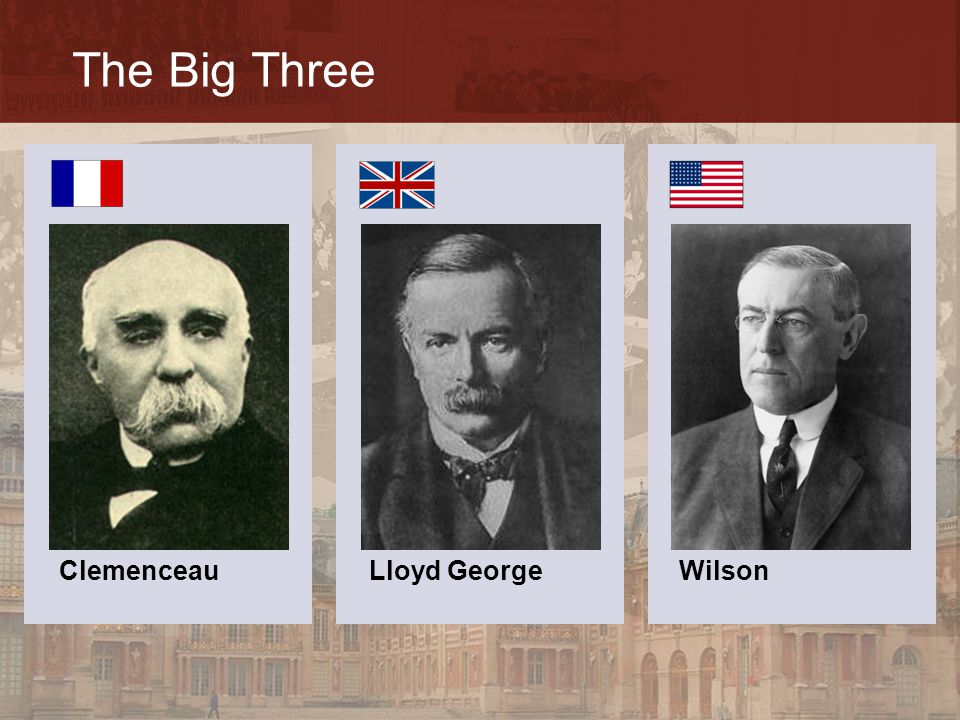
- Georges Clemenceau (Prime Minister of France)
-
Why was the Palace of Versailles chosen as a venue, where is it?
The Palace of Versailles is in France and was chosen because that was where Germany was made a country after the Franco-Prussian war in 1871. It was a symbol of revenge, undoing what had been done in that very room, The Hall of Mirrors. -
What was the League of Nations?
The League of Nations was the first worldwide intergovernmental organisation whose principal mission was to maintain world peace. It was similar to the United Nations, but had much less power than the UN, which ultimately replaced it. -
What was the “Fourteen Points” constructed by Wilson?
- Open diplomacy
- Freedom of the Seas
- Removal of economic barriers
- Reduction of armaments
- Adjustment of colonial claims
- Conquered territories in Russia be returned
- Preservation of Belgian sovereignty
- Restoration of French territory
- Redrawing of Italian frontiers
- Division of Austria-Hungary
- Redrawing of Balkan boundaries
- Limitations on Turkey
- Establishment of an independent Poland
- Creation of an Association of Nations
Sources
https://www.savemyexams.com/igcse/history/cie/18/revision-notes/the-20th-century-international-relations-from-1919/was-the-treaty-of-versailles-fair/motives-and-aims-of-the-big-three-at-versailles/
https://www.bbc.co.uk/bitesize/guides/zbg4t39/revision/2
| Territorial | Millitary | Financial | General |
|---|---|---|---|
| Areas controlled by Germany were given to nearby countries | Limited to 100,000 men | Pay reparations (33 billion USD) | The League of Nations was established to stop other wars by undertaking negotiations instead |
| Limit areas where Germany could hold munitions | Air force disbanded | Germany lost 10% of its coal reserves, 15% of its agricultural land and 48% of its iron reserves | |
| German colonies were divided between the Allies. | Weapons and munitions production was strictly controlled and monitored | ||
| Japan was allowed to keep Germany territory in China that they had seized | No tanks, heavy artillery, or enforced conscription | ||
| Lost 13% of its European territory | |||
| The Saar coal fields were given to France for 15 years |
The Germans believed they were hard done by and that they had been betrayed.
Research Task 2 - The Roaring Twenties
After so much death and destruction all people wanted to do is let it all go – The Roaring 20s!
They wanted to:
- Make the most of peace/life
- Enjoy the economic boom in the USA & other Allied nations
- Be rewarded by the major social changes
But there were negatives - The Spanish Flu
- Many families dealing with the loss of loved ones
- Many soldiers left disabled
All this was topped off by the Great Depression.
Write a 100 word description of what life would be like for a man or woman aged either 20 or 40 immedatiatly after WWI.
Assuming a 40 year old man had returned as a soldier from WWI, he would likely have had to deal with Shell Shock (PTSD), but as mental health was not well understood back then, it would be difficult or shameful to talk about. There was also the problem of jobs, because the wartime job boom had dwindled and it was likely that the job a man held before the war had been filled by someone else. There were also changing family dynamics and gender roles, as women had become breadwinners for the family while the husband was at war. Many men also had physical disabilities after the war, requiring some to lean on the help of others to get through day-to-day life.
Research Task 3 - The Great Depression
Investigate the effects of the Great Depression in Australia, Germany and the USA. Why was the economic impact so widespread?
USA
The Great Depression started in the USA because of declining spending after the Roaring Twenties, the stock market crash and multiple bank panics. The Great Depression left ~25% of US citizens without a job, about one third of farmers lost their land, and around 9000 of the US’s 25,000 banks closed because of the Depression.
Germany
Germany relied heavily on US loans after WWI to keep their economy alive, so when they were no longer available their country went into a heavy decline. Around 30% of German citizens did not have a job and they gradually lost faith in democracy, instead turning to extremist groups like the Communists and the Nazis.
Australia
In the 1920’s Australia’s main source of money and prosperity was from agriculture. We had already undergone a recession from 1919 to 1923, and just when Australia was starting to recover, other European countries did as well and they started flooding the agricultural market, including with sheep and wheat, our primary exports. In April 1925 Winston Churchill returned Britain to the gold standard, but he overestimated it’s value, so British exports became more expensive, and because Australia’s pound was based on the British pound, our exports were affected as well.
Depression unemployment rose to a high of 32% in 1932. Suicide rates increased dramatically and there was an overwhelmingly large number of people who were unable to pay for food.
Why was the economic impact so widespread?
Mainly because there was a lot of lending from banks that was unable to be paid back. There was a high reliance, especially in Australia and Germany on loans from the US and Britain to keep the economy going. Along with many countries reliance on the Gold Standard made the economic impact be felt worldwide.
Research Task 4 - Rise of Nazism
Explain the reasons economically and politically for the rise of Hitler and the Nazi party.
Germany found the punishments imposed by the Treaty of Versailles to be oppressive and debilitating for the German people to pay back. Additionally, because of Hyperinflation (1923) and the Great Depression (1929), millions of Germans lost their jobs and found it difficult to pay for food, housing and other necessities. This drove many citizens to back extremist groups that promised stability and order. Because many Germans feared the Communists more than the Nazis, the Nazis eventually won. Then the Nazis used Reichstag Fire to suspend civil rights, passed the Enabling Act to rule by decree and eliminated opposition through the Night of the Long Knives and the death of President Hindenburg, establishing a totalitarian dictatorship.
Button orange