With the outbreak of war in 1914 the government required German subjects in Australia (and soon Austria-Hungarians as well) to report to their nearest police station. By 1916 the War Precautions (Alien Restriction) Regulations required all aliens (that is, non-British subjects) aged fifteen and over to register.
In 1911 there was 33,381 German born residents in Australia. During WWI 6,890 Germans were interned, of whom 4,500 were Australian residents before 1914; the ret were sailors from German navy ships or merchant ships who were arrested while in Australian ports when the war broke out, or German citizens living in British territories in South-East Asia and transported to Australia at the request of the British government.
Since the government couldn’t intern every enemy alien, they pursued a policy of selective internement. They targeted leaders of the German Australian community. Some internees had been accuses from being disloyal by neighbours or had come to the attention of the police by accident.
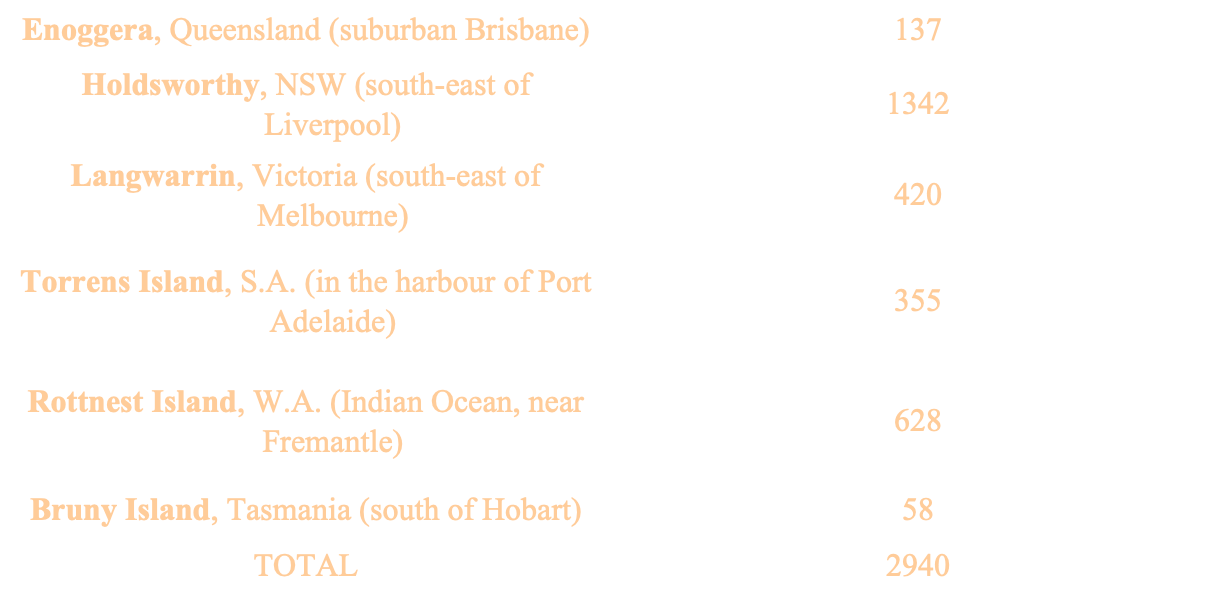
Holsworthy camp in Liverpool was the largest and longest running internee camp, hosting 6000 men at its peak from all different nationalities.
The camp grew from a collection of tents to a small town of huts complete with theatres, restaurants and cafes, other small businesses, an orchestra and sporting and educational activities. Physical conditions in the camp were difficult. Living conditions were overcrowded and sanitary facilities were basic. There were also reports of corrupt or brutal guards working in the camp, which remained open until 1920.
Of all the camps Holdsworthy was the harshest and resembled a prison in the true sense of the word. A strict regime of control was enforced by the camp authorities and a prisoner was killed during an attempted breakout
The Trial Bay camp was situated in an old gaol near the entrance to the Macleay River in northern New South Wales. It held 580 men at its peak; most were of higher social standing.
The camp was located on a peninsula, separated from the mainland by a boundary fence. Inside the boundary internees were free to swim, fish, sunbathe or play tennis on the courts they had constructed. They were allowed to leave the camp to collect wood for the kitchen or bring water from the well on the hill behind the camp.
Handling the Alien Threat
- People with German sounding names were targeted regardless of whether they were actually German or of German descent.
- German businesses were boycotted.
- Many place names were Anglicised such as Germantown Hill became Vimy Ridge and Grunthal became Verdun.
- German shepherd dogs were called Alsatians.
- German sausage (Berliner) became known as Devon.
- German language schools and German church schools were closed.
- The Department of Education ordered that no German speaking teachers or those with a German background be employed for fear of propagandising the students.
- Elected officials with German backgrounds or surnames were forced to resign.
- Trade with Germany ceased and the traders went out of business and this had the immediate effect of increasing Australian beer sales.
The Victorian Anti German League began in November 1915. Members signed the following:
Quote
I hereby sincerely and conscientiously promise
a) Not to knowingly purchase, use or consume German or Austrian goods of any kind
b) Not to employ a German for either domestic or commercial purposes
c) Not to place contracts with any German owned or controlled company or to send goods or travel in German ships
d) To boycott and assist boycotting of any trader who persists in stocking Austrian or German goods.
At the end of the war, 6150 Germans and other enemy alien nationals were deported.
Research Activity
Research one of:
- Holsworthy Camp
- Trial Bay Camp
- Torrens Island
- Berrima Camp
- Rottnest Island
Investigate:
- conditions
- treatment
- daily life
- significance
- perspectives of internees
Australian War Memorial — “Enemy Aliens” follow this link and answer questions 1 a to f and questions 2 a to f.
Research
Source
https://www.migrationheritage.nsw.gov.au/exhibition/enemyathome/berrima-internmentcamp/index.html
Conditions
While initially the conditions at Berrima camp were not good they did improve over time. When the first internees arrived in March 1915, the Gaol had been hurriedly cleaned and there were no beds for the internees to sleep on. Those who had money were allowed to buy a bed from furniture stores, but those who didn’t made their own out of timber from the forest. They also had to cook their own food and the temperature in the cells was very uncomfortable; it was freezing in winter and boiling hot in summer. The cells were made more comfortable over time, although the amount of people interned at Berrima camp also swelled over time to a peak of almost 300 although the gaol was only designed to hold 140 prisoners and their guards. Internees were allowed to go up to 2 miles away from the gaol in the day so long as they were back by 5pm for roll-call.
Treatment
Guards treated the internees with mutual respect, tolerance and friendliness. Most guards and villagers understood that the internees had not done anything wrong and were just trying to make the best of their situation. Internees were allowed as much independence and freedom as possible.
The villagers in Berrima, although initially slightly culture shocked, soon grew to appreciate the prosperity that the internees brought to the town, as they bought large amounts of meat, bread and other foodstuffs from the villagers.
Daily Life
Internees were allowed a lot of freedom; they organised activities like athletics, wrestling and gymnastics to stay fit, as well as project like creating pleasure grounds on the Wingecarribee river. There were multiple activities internees could do such as theatre, joining the camp orchestra or attending lessons. A special German girls’ school was set up so that younger girls interned there could still learn.
Significance
WDYM?
Perspective of the Internees
The internees tried their best to enjoy the strange and unfair situation they were put in. While they weren’t happy about it, they recognised there wouldn’t be much they could do until the end of the war, so they made the most of their stay.
Questions
Q1.
a. What does it mean to be interned?
To be interned as a German during World War I in Australia meant being classified as an “enemy alien” and detained in military camps without trial or charge, based primarily on ancestry rather than criminal conduct.
b. How is an internee different to a prisoner of war?
Prisoners of war (PoW) are members of the enemy army held in custody because they are on the “other side,” while internees are civilians held for security reasons. Internees were often treated better as their treatment guidelines were different to PoWs.
c. Find the locations of some of the camps around Australia, and investigate the camp conditions.
Berrima, see above.
d. What happened to the internees when the war ended?
Those who were from Germany were shipped back and those that were Australian were allowed to live in their own homes again.
e. Could women and children be interned?
Yep.
f. What do you think about the internment of civilians during times of war?
While it wasn’t fair for most people, it was understandable for security reasons why they were interned. They were treated fairly well overall, and while most internees were not affiliated with the German of Austria-Hungarian government, it is understandable why they were interned.
Q2. Not all Australians of German heritage were interned, and some German migrants and their descendants served with the Australian Imperial Force. Read the case studies of Adolphus Schmahl, Eric Ernest von Bibra, and George and Herbert Heinecke.
a. Discuss the home front and service experiences of the men. What challenges did they face due to their German heritage?
Most of the men were accused of being disloyal simply because they were German. George and Herbert Heinecker’s father especially, even when both of his sons died fighting for Australia was still accused of being a German spy.
b. For those who returned home, did their service have a positive impact on their place in society? Use examples from the case studies to support your opinions.
Yes, they did Adolhpus Schmal was awarded medals and so was his family, and Eric Ernest von Bibra became State Secretary of the Tasmanian RSL and Mayor of Launceston for a year.
c. These men saw action against Germany in Europe. What do you think it would have been like for them to fight against the nation that was home to their ancestors?
I can’t be sure, but with the amount of propaganda going around at the time, and as they were born Australians (most of them) they likely saw themselves as Australians fighting against the enemy, even if they were of German ancestry.
d. Why do you think they wanted to serve for Australia?
To prove that they weren’t German spies.
e. How did Australian society respond to men who chose not to enlist during the First World War?
Most Australians responded with suspicion or open accusation that the German-Australians were spies.
f. Do you think this response differed for those born in Australia and those born overseas?
This question is badly worded.
Those born in Australia were accused of cowardice, while those from overseas or of alien ancestry were likely accused of being spies.
Button orange