Glossary
bourgeoisie a term to describe the growing French middle class who had accumulated some wealth but no political representation before 1789
French Revolution Textbook Summary
In the 1700’s France had three social classes:
- The Clergy and Church Officials (The First Estate, 100,000)
- The Nobility (The Second Estate, 400,000)
- The remaining 98% of the population (The Third Estate / The bourgeoisie, 22.5million)
- This included lawyers, bankers, and wealthy landowners
Enlightenment ideas were popular with all social classes, even clergy and nobility (in private, of course). In the cities enlightened bourgeoisie discussed enlightened ideas in coffee shops. Strict censorship laws prevented these ideas from being published but in 1788 King Louis overturned these laws in preparation for an Estates General Meeting. What followed was an explosion 💥 of published pamphlets, known as the Pamphlet War. The most influential was written by a priest named Abbé Sieyès.
In the Estates General meeting, the wealthy bourgeoisie chosen to attend were humiliated by its formality and were unable to communicate their ideas to the king. In the ned they were locked in an indoor tennis court and not allowed to enter proceedings, but they refused to leave until they were recognised as representatives of the people: the National Assembly.
On 14 July 1789 a mob marched on the largest symbol of royal power: the Bastille Prison, where they beheaded its commander. 💀
After the fall of Bastille the National Assembly became the new government of France and wrote the Declaration of the Rights of Man and Citizen. 📜
- This included lawyers, bankers, and wealthy landowners
Jean Jacques Rosseau
He wrote The Social Contract that “man is born free and everywhere he is in chains.” Seiyès read a lot of John Locke who’s central thesis was that all individuals possess natural rights to life, liberty and property
French Revolution Textbook Activities
Activity 1
Sieyès, A., 1789, What is the Third Estate?
What is the Third Estate? Everything.
What has it been until now in the political order? Nothing.
What does it want to be? Something. …
What, then, is the Third Estate? All; but an ‘all’ that is fettered [shackled] and oppressed … It is alleged that the Third Estate cannot constitute the States-General by itself. So much the better! It will form a National Assembly.
- Identify which Enlightenment thinker Seiyès is referencing when he says the Third Estate is ‘shackled and oppressed’.
- Apparently Jean Jacques Rosseau? “Man is born free, and everywhere he is in chains.” - The Social Contract
- Explain how Seiyès’ pamphlet reflected Enlightenment thinking.
- He begins by outlining the current state of the Bourgeoisie (nothing), then declares that it must be something better, that a better life is required for the lower classes. It sows the seeds of better things in the minds of the Third Estate, prodding them to consider that they may be worth more than they thought: that it’s important they be able to cater to their own needs.
- How does Sieyès propose that he will take Enlightenment thought and put it into action?
- He proposes that the Third Estate form a National Assembly in order to govern themselves more fairly.
Activity 2
Research an overview of the Declaration of the Rights of Man and Citizen.
- How does it reflect a radical change for France?
The Declaration of the Rights of Man and Citizen reflected a deep desire in France that all men be given the same set of basic rights, including life, liberty and property. It also declared that the role of the government was to ensure that all men had access to these rights; not to laze around all day in luxury. - Identify what stands out to you as its key achievement.
The declaration that the government’s purpose is to ensure men have access to their natural rights. - Reading the document in a modern world, explain what ideas appear to be missing.
It doesn’t give any of the ‘basic rights’ to women. - Explain in a brief paragraph how this document was a significant moment for ideas and movements.
This document gave men significant rights, and while it didn’t immediately fix the problems there were in France, it did get the Bureaucracy train moving. It proved that when people banded together they could create change.
Timeline
Mostly verbatim notes from the PowerPoint
The Growing Discontent
- The 1700’s the population of France grew
- The nobles and clergy both attempted to gain revenue
- The bourgeoisie wanted political power
- The nobles and clergy resented the power of the king and the bourgeoisie. The third estate wanted liberty and equality
- The Ancien Regime or old order is divided into three classes or estate which causes widespread resentment.
Financial Crisis in France in 1989
- In the 1700’s the population of France grew.
- The Nobles and Clergy both attempted to gain revenue.
- The Bourgeoisie wanted political power.
- The Nobles and Clergy resented the power of the king and the bourgeoisie. The Third Estate wanted liberty and equality.
- The Ancien Regime or old order is divided into three classes or estates which causes widespread resentment.
Formation of the National Assembly
King Louis is like yo, everyone go and vote, but the Third Estate says no, and proclaims itself the National Assembly. Then Louis gets mad and slams and locks the doors to the court rooms on them, so the National Assembly take the Tennis Court Oath and create the Declaration of the Right of Man and Citizen. Then they storm Bastille Prison to get guns and free prisoners.
The End of the Old Regime
General Lafayette takes control of Paris with the National Guard. He changes the flag of France to the one they have today: Blue, White and Red. The National Assembly takes control of the government and proclaim the famous: “Liberty, Equality, and Fraternity.” The Assembly rejects the rights of the women though.
Quiz!
- Who made up the first estate?
The clergy and church officials - What was one criticism of the first estate?
They kept on increasing taxes and ignoring the needs of the Third Estate. - What was one service that they provided?
The Church. - Who made up the second estate?
The nobility. - What was one criticism of the second estate?
They kept increasing taxes. - What was one service that they provided?
Not pay taxes. - Who made up the third estate?
The other 98% of people, including the bourgeoisie. - What was one criticism of the third estate?
They were poor. - What was one complaint of the peasantry?
“We don’t have any food!” - The parliament of France was known as what?
The Estates General.
Reforms of Government
- The Emigres (the people who are in danger of being beheaded) flee to Great Britain, Italy and Germany.
- The National Assembly divided France into 83 districts called departments.
- Clergy now have to be elected
- The constitution of 1791 was approved and the National Assembly. was dissolved.
- Louis tries to flee France.
- Legislative Assembly divides into conservative, liberal and moderate.
Fun Fact! Left and right wing comes from where the National Assembly sat in the hall where they met.
End of Monarchy
- Austria and France both say: we’ll save France by invading it!
- The Commune takes control of Paris
- The Legislative Assembly abolishes the monarchy
- National Convention draws up new Constitution.
- Louis XVI is executed on Jan. 21 1793.
National Convention
- The French elected delegates to the National Convention using universal manhood suffrage in 1792.
- On the right side or the conservative side were the Girondists and on the left were the radical Jacobins.
- Marat was one of the sans-culottes (means ‘with trousers’).
- The National Convention had Louis XVI executed.
Quiz!
- What was the government assembly created by the constitution developed by the National Assembly?
- This new assembly was divided into what three sections or divisions?
- The leader of the French National Guard was Marquis de Lafayette?
- The nobles that fled France were known as Emigres?
- The working class citizens of Paris and cities became known as sans-culottes, because they wore trousers.
- Name the document that stated that the King of Austria and Prussia might invade France: The Declaration of Pillnitz
Exporting the Revolution
- The French have initial success in battle and want to spread the Revolution.
- The Monarchies of Europe combine to form the first coalition.
- The Committee of Public Safety set up to protect France.
- The Revolutionary Tribunal is set up to try enemies of the state.
- The Americas start to get ideas…
The Commitee of Public Safety
The Committee begins to Draft recruits. Conscription. All men between the ages of 18 - 45.
Counter-revolutionary work done by the French nobility.
Charlotte Corday kills Marat
Jacobins - Danton and Robespierre oppose the Girondists
The Reign of Terror
- From September 1793 - July 1794
- The National Razor beheaded anyone (via guiottine) who they thought was disloyal to the state
- Robespierre turns on Danton and has him executed
- Robespierre is put to death by The Commitee of Public Safety on July, 1794
- National Convention codifies law, and the metric system (WOW!)
Why Was the French Revolution so Important?
- It introduced new ideas like Libery, equality, fraternity
- It brought people to the forefront of politics
- Set the model for later revolutions
- Changed the political map of Europe
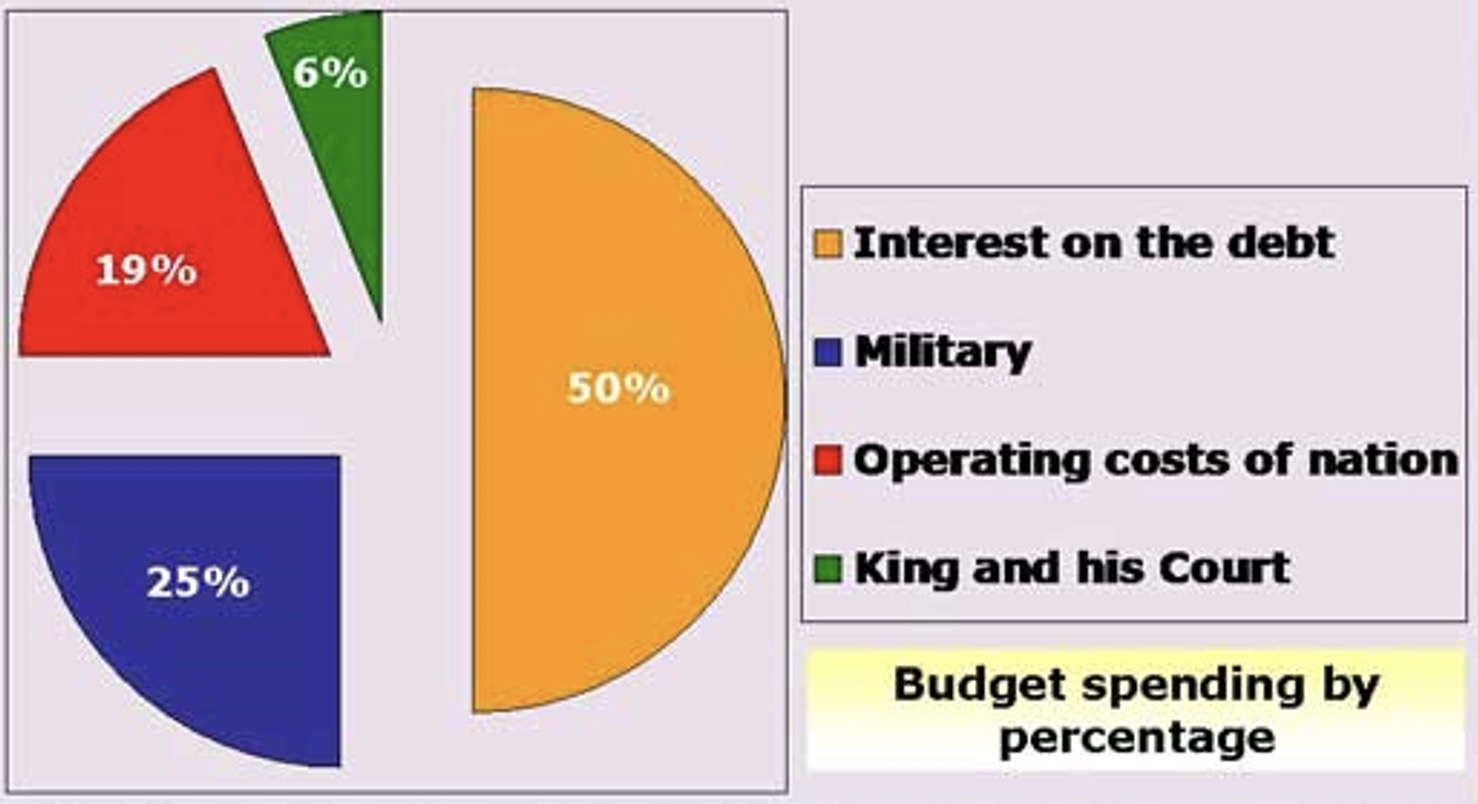
France’s Spending in the 1780’s
The Failure of Absolutism
The French King had complete and unchecked power over everything and everyone under his control.
- Ruled by divine right as God’s representative
- Possessed virtually unlimited power ie despot
- Consulted with ministers and advisers
- Drew up edicts sent to parlements (law courts) which became laws
- Could enforce law by lit de justice if necessary
- Letter de cachet gave the king the right imprison anyone
- Was superior to laws but could only pass laws that would benefit the whole kingdom (in theory)
Influence of the French Enlightenment
- Many of the most progressive ideas and developments had taken place in England in the 17th Century
- Isaac Newton (Science) and John Locke (Politics)
- Initially applied science and reason to the natural world
- Later applied reason to social order questioning the existing order and authority
- Becomes basis of modern science and politics
- Admired English constitutional monarchy compared with French despotism
Famous French Philosophers
-
Diderot
-
Voltaire
-
Montesquieu
- Principal source of the theory of the Separation of Powers
- Anonymously published The Spirit of Law
- Published Considerations on the Causes of the Greatness of the Romans and their Decline
- His most influential work divided French society into three classes: the Monarchy, the aristocracy, and the commons.
-
Rousseau
- Jean-Jacques Rosseau: A French philosopher who fled France and settled in Switzlerand after his book The Social Contract was banned.
- Published The Social Contract which was banned almost immediately by the Catholic Church
- Greatly influenced Immanuel Kant’s work on ethics
- Tried many times to describe and outline a legitimate political order in many books
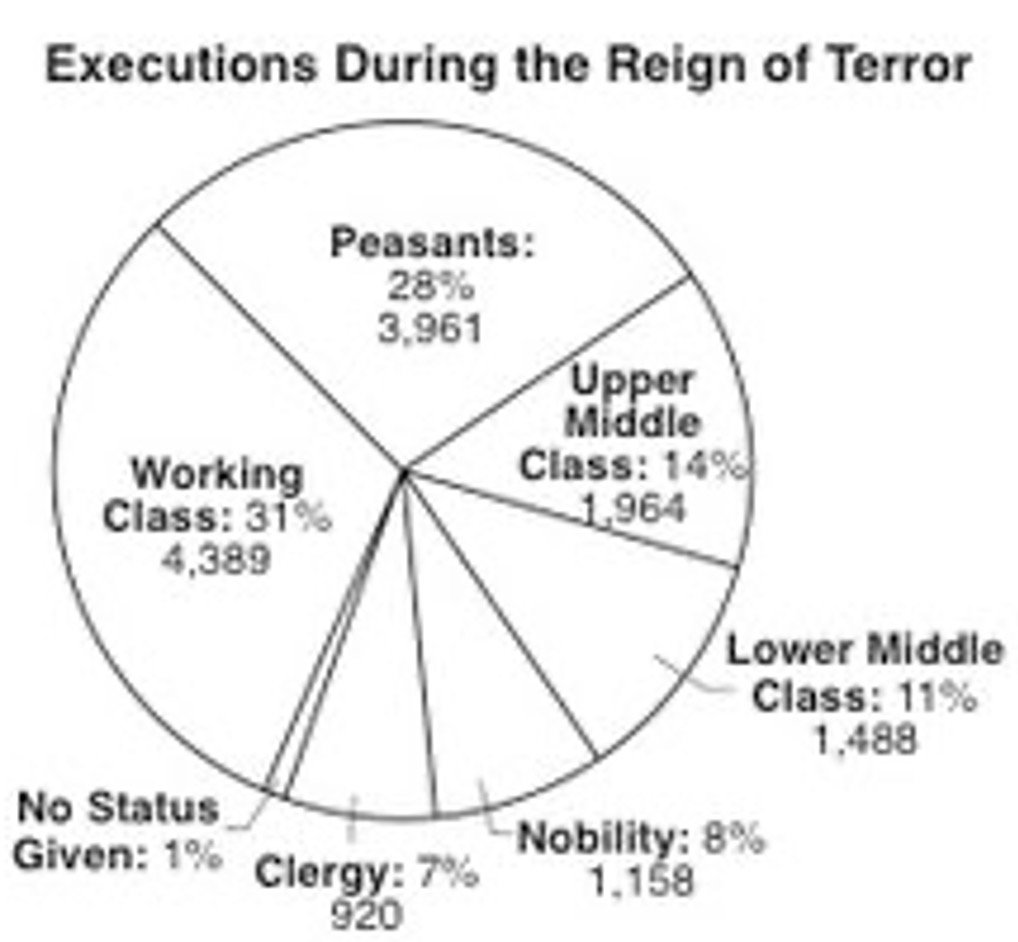
How Did the Reign of Terror Impact France
Around 2/3 of the people executed in the Reign of Terror were from the Third Estate.
How did Rebespierre justify the Reign of Terror?
He said loads of fancy political stuff, then said we need to kill all our enemies, or they’ll kill us.
Why Was Robespierre Executed?
Three dp
- Robespierre had purged (by execution) the members of The National Convention many times, and on his address on the 26th of July 1794, he spoke of ‘internal enemies’ and their need to be executed.
- Jean-Lambert Tallien, whom Robespierre had in mind to execute, turned the Convention against him in their fear of their execution.
- Robespierre was executed on the 28th of July 1794.
Button orange