Imperialism Symbols
Look at the last 2 slides of PROG4 (Rule Britannia! and White Man’s Burden) and highlight all references that could be considered symbolic of Imperialism.
[! quote] Rule Britannia!
“Rule, Britannia! rule the waves:
“Britons never will be slaves.”
[! quote] Rule Britannia!
The nations, not so blest as thee,
Must, in their turns, to tyrants fall;
While thou shalt flourish great and free,
The dread and envy of them all.
Take up the White Man’s burden—
Send forth the best ye breed—
[! quote] White Man’s Burden
To seek another’s profit,
And work another’s gain.
Savage wars of peace
British Imperialism and Its Impact (Notes from slides)
Forms of Imperialism
- Colony (E.g. Egypt)
- Protectorate (E.g. The British established a Protectorate over the Niger River delta)
- Sphere of Influence (E.g. the British had a sphere of influence over China)
- Economic (E.g. The British East India Co. with tea trade in India and China)
- Cultural / Linguistic Imperialism (E.g. Cricket in India and Pakistan, English as the “international” language)
Imperialism Management Methods
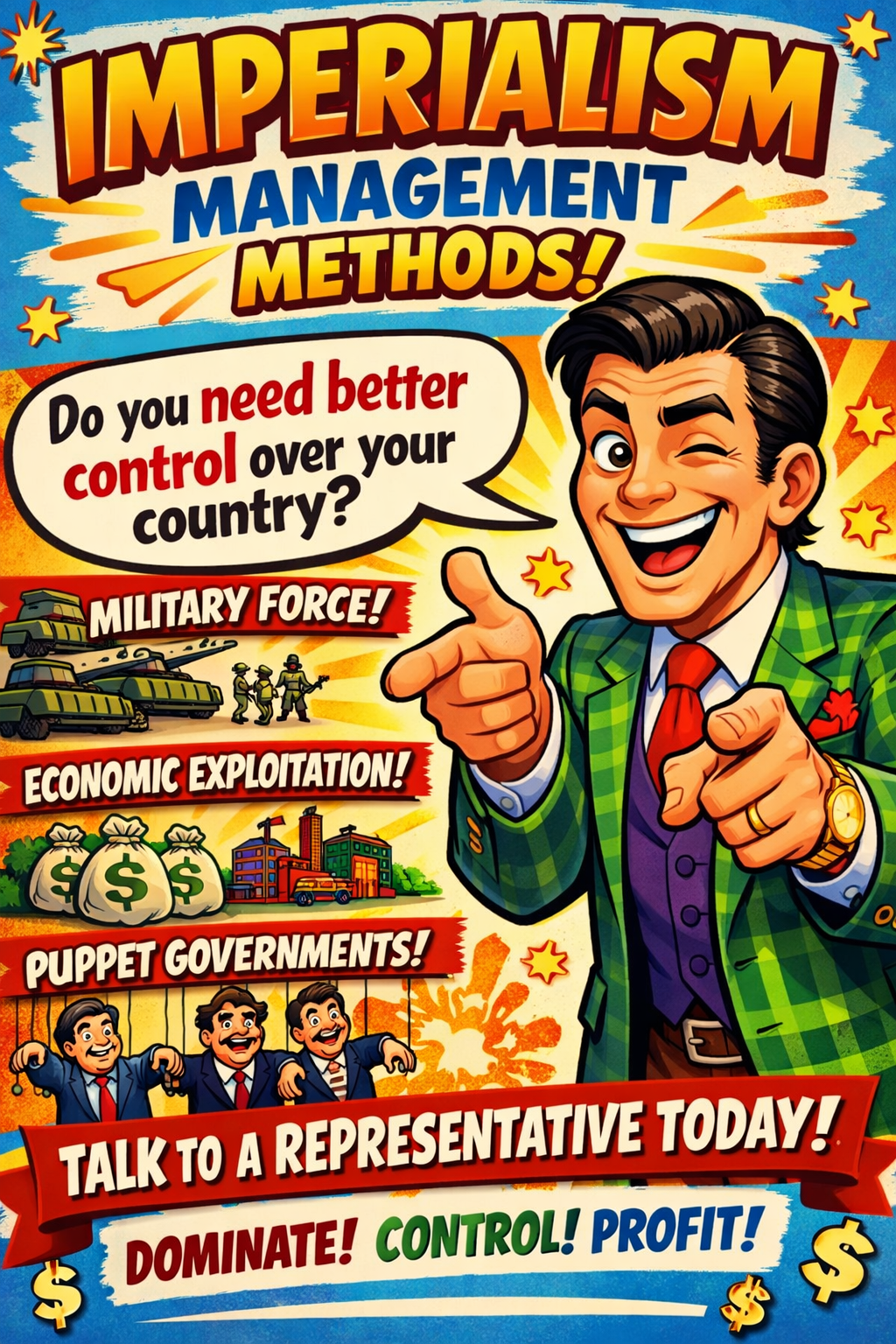
This image was generated by AI
- Direct Control
- Foreign officials brought into rule
- No self-rule
- Government and institutions based on “European Models”
- Ultimate goal - Assimilation
- Indirect Control
- Local government officials used
- Limited self-rule
- Government and institutions based on “European Models” but nay have local rules
- Ultimate goal - to develop future leaders
The Brits Giving Up Control
After WWI and even more after WWII, the world slowly decided that colonisation and imperialism were not great, and we should probably work towards colonies ruling themselves instead. The first the British ‘let loose’ was India, then more countries soon followed. After the 1960’s international pressure was ever increasing that colonies should be allowed to be independant, and eventually the British Empire gave up most of her colonies.
Impact of Imperialism
- Indigenous culture and language
- Economy
- Spiritualism and religion
- Rights and freedoms
- Living conditions
- Government and control
- Environment
Student Investigation
Investigate the impact of British Imperialism on the indigenous peoples of the following colonies:
- Australia 🇦🇺
- New Zealand 🇳🇿
- ➡️ India 🇮🇳 ⬅️
- Canada 🇨🇦
Investigate the impact on:
- Culture
- Religion and spirituality
- Education
- Rights
- Economic development
Investigation Report
Useful Quotes and Info
[! quote] History Crunch [^1]
First, Britain viewed India as a source of raw materials that could be used to fuel the factories in England. At the time, India economy was largely centered around agriculture, which would then be exported to England. The most common of these agricultural resources included: jute, cotton, sugar, tea, coffee and wheat. Second, India proved to be an important market for the goods that were developed in British factories. As a result, the British benefitted from selling goods to the people of India.
There were many famines in India, such as the Great Famine from 1876-1878, which led to the death of 6-10 million people. This was while Indian farmers were forced to produce crops for use in English factories.
[! quote] History Crunch
For example, in 1880, the average life expectancy in India was around 25 years of age. However, by 1950 it had increased to 35 years of age. Again, some historians point to this as proof that British rule led to improved health and quality of life standards for the people of the Indian subcontinent. These improved health statistics were likely achieved from new hospitals and schools that were developed by the British during the time of imperial rule. These new schools trained Indian doctors and nurses, which helped improve health standards across the country.
Almost all high-up jobs in the Indian government were held exclusively by Britons. This is usually equated to mean that the Indians were not able to attain self-rule, because they were denied the ability to rise in government.
Sources
- https://en.wikipedia.org/wiki/British_Raj
- [^1] https://www.historycrunch.com/british-imperialism-in-india-impacts.html#/
- https://blogs.lse.ac.uk/humanrights/2023/07/12/beyond-the-raj-how-british-colonialism-continues-to-impact-human-rights-in-india/
- https://www.dawn.com/news/539911/how-the-british-influenced-indian-culture
Button orange