Define rate of reaction
The rate of a reaction is a measure of how quickly a reactant is used up, or a product is formed. Source
Outline some factors that affect rate of reaction
- Temperature (higher=faster)
- Concentration (higher=faster)
- Presence of a catalyst
- Surface area (higher=faster)
- Pressure (higher=faster)
Tabulate rate of reaction data & Construct a graph using excel & Propose a hypothesis and make a prediction & Conduct a risk assessment & Identify the dependent, independent and controlled variables in fair test & Assess the validity and reliability of a fair test, evaluate conclusions, identify sources of uncertainty and suggest improvements
PRAC: TO INVESTIGATE THE EFFECT OF TEMPERATURE ON REACTION RATE
Aim: To investigate the effect of temperature on reaction time.
Hypothesis: The higher the temperature, the faster the reaction time.
Risk Assessment
- Acid can cause chemical burns to eyes, wear goggles
- Sulfur dioxide gas will / may be produced by reaction, don’t be stupid
- Reaction may generate hydrogen sulfide (rotten egg gas), turn taps on and leave them on and pour solution down the sink
Variables
Independent: Temperature of water
Dependant: Reaction time
Controlled: Volume of water, concentration of acid, amount of acid
Method
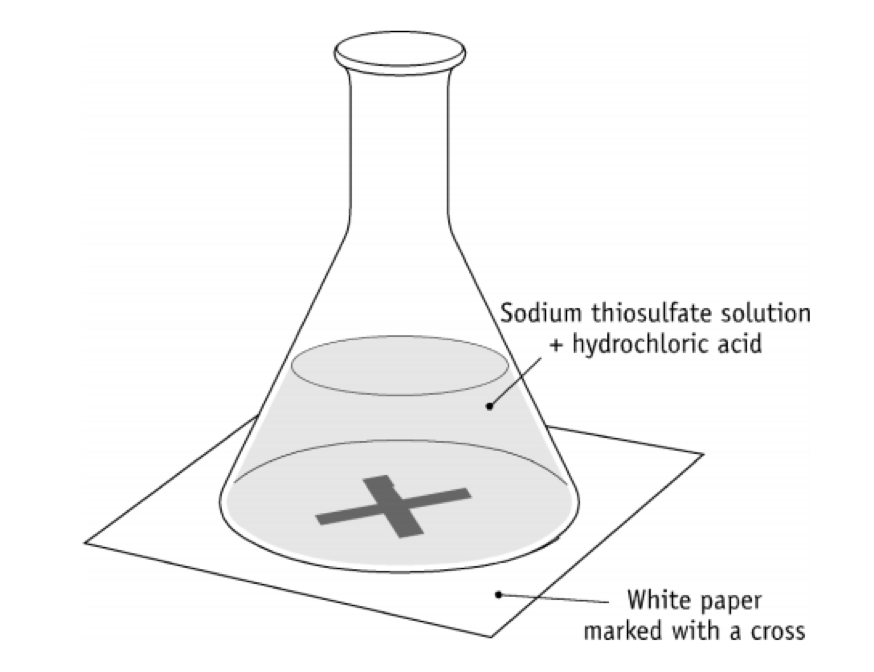
- Add 25ml Sodium Thiosulfate solution into a 250ml beaker.
- Add 25ml of distilled room temperature water to the beaker
- Place on a piece of paper marked with a cross.
- Add 5ml Hydrochloric acid, starting the stopwatch at the same time.
- Stop the stopwatch when the cross is no longer visible
- Repeat the procedure using 25ml of water at 5, 45, 65, 85 degrees. Make sure you clean thoroughly between each trial.
Results
| Temp (degree C) | Time to conceal (s) |
|---|---|
| 10 | 22 |
| 16 | 14 |
| 28 | 8 |
| 32 | 7 |
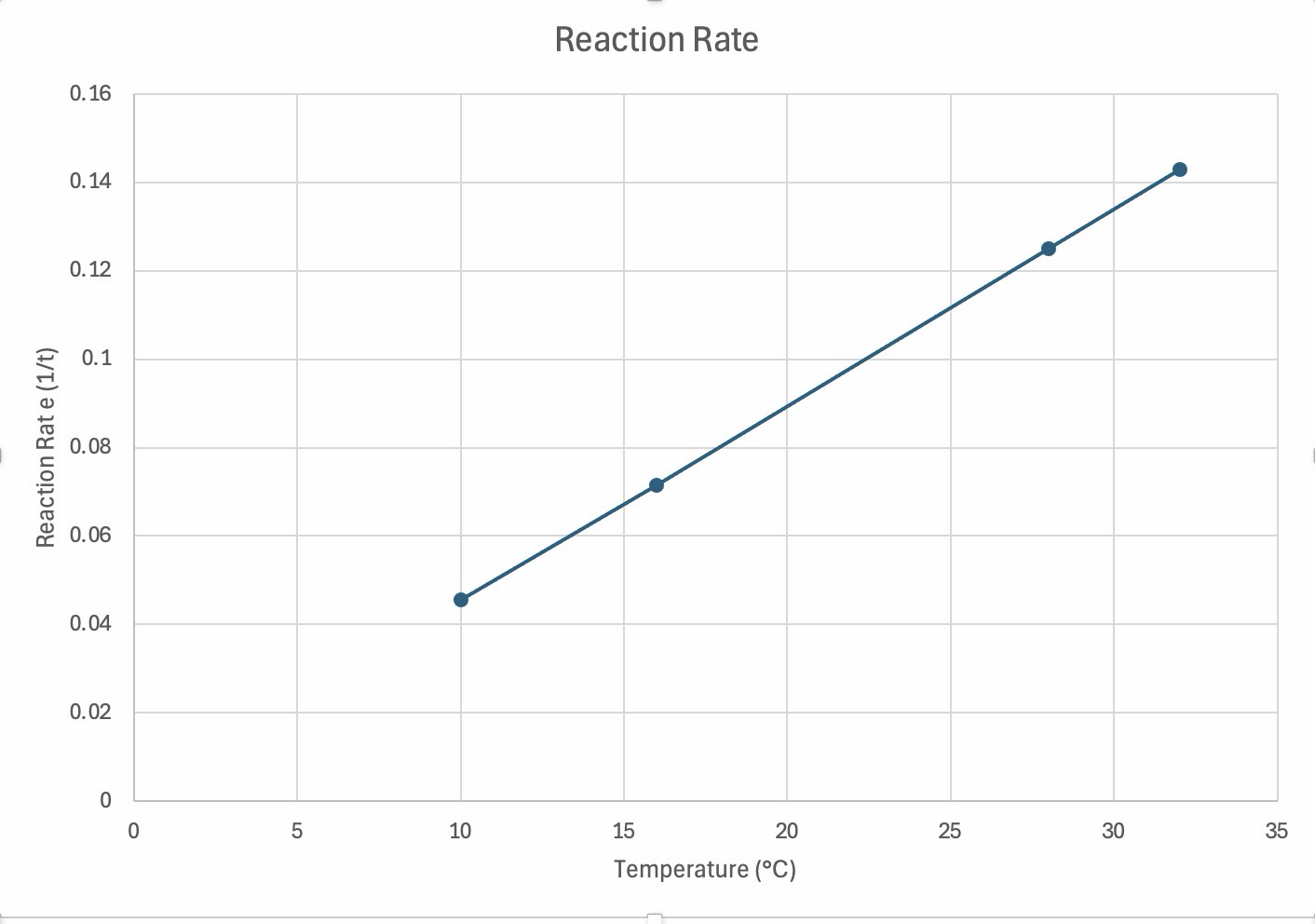
| Reaction Rate (1/t) | Temperature (°C) |
|---|---|
| 0.045454545 | 10 |
| 0.071428571 | 16 |
| 0.125 | 28 |
| 0.142857143 | 32 |
 |
Conclusion
State the relationship between temperature and reaction time.
As temperature increased, reaction time decreased.
Comment on whether the results supported or disproved your hypothesis.
The results supported my hypothesis.
Propose a scientific reason to explain your result.
Because temperature increases, the particles in the reactants become more excited, increasing the rate of collision, leading to more successful collisions, leading to product being created quicker.
Discussion
Explain the relationship shown by the graph.
There is a linear relationship between temperature and reaction rate.
Assess the validity of this investigation (consider you variables)
We controlled our variables:
- The same beaker
- The same cross
- The same concentration of acid
- The same amount of acid
Assess the accuracy of this investigation (consider the measurement tools you used)
We used our eyes to judge our ability to see the cross, which is qualitative, and used an analogue thermometer to measure temperature, although that should not have affected the results.
Assess the reliability of this investigation (consider repeated trials)
AI was used to generate this answer
The investigation has low reliability because each temperature was tested only once. A single result may be affected by random errors, such as differences in judging when the cross disappeared or stopwatch reaction time. The experiment should be repeated at least three times for each temperature, then the mean reaction time and rate should be calculated. Any anomalous results could be identified and investigated, making the conclusion more reliable.
Analyse secondary data on rates of reaction
No.
Button blue