Disclaimer: This content is summarised from the PowerPoint in OneNote.
Glossary
Dissolution: The process of a solute dissolving in a solvent to form a solution.
Precipitation: The process where a solid forms and separates from a solution.
Ionisation: The process by which an atom or molecule gains or loses electrons to form ions.
Dissociation: The process by which an ionic compound separates into its individual ions when it dissolves in a solvent.
Cation: A positively charged atom (i.e. has lost an electron)
Anion: A negatively charged atom (i.e. has gained an electron)
Dissolution
Dissolution is the process of a solute dissolving in a solvent to form a solution.
In our case, dissolution usually happens with a salt.
Salt (+ water) -> Cation + Anion
The water is left out of the product because dissolving is not a chemical reaction, it is a physical change.
E.g.
That’s right, you still have to balance the equation.
Precipitation
In a precipitation reaction, tow soluble salts react to form an insoluble salt and a soluble salt. The insoluble salt is called the precipitate.
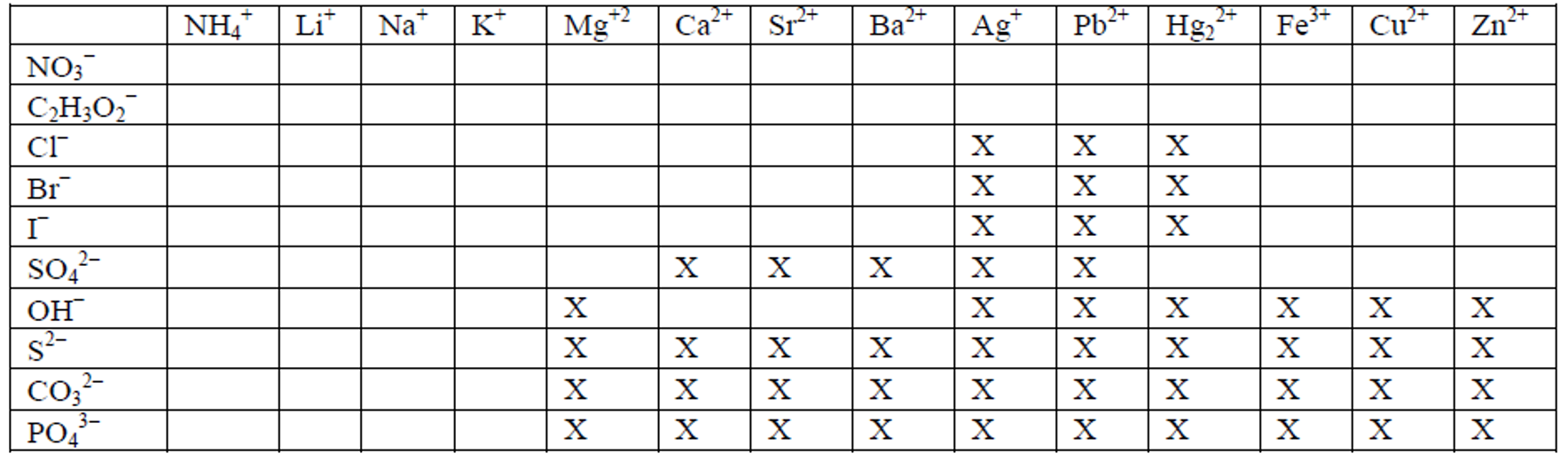
A solubility table is used to predict which salts will form a precipitate and which will not.
My favourite solubility table (where X means insoluble):
Another solubility table:
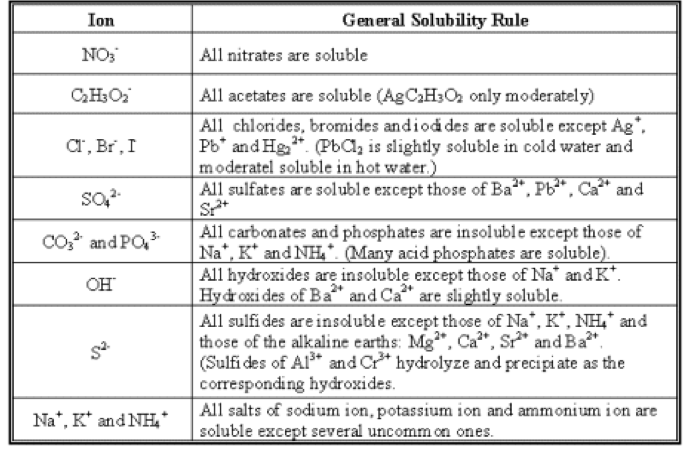
To solve a precipitation reaction, first swap ions to get products, then apply solubility rules and balance the equation. The order to swap ions is: AB + CD -> AD + CB.
Example
Lithium Carbonate + Calcium Nitrate -> Lithium Nitrate + Calcium Carbonate
Note that the precipitate has been placed last in the equation, but it can be placed as the first product if desired (like in many textbooks).