Outline the steps in the discovery of the structure of DNA, including the work of Avery, Chargaff, Franklin, Watson & Crick
- Avery found that destroying DNA stopped transformation, but destroying protein did not.
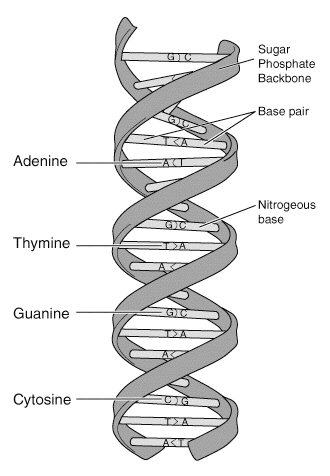
- Chargaff stated that there was the same amount of Ademine (A) and Thymine (T), as well as the same amount of Guanine (G) and Cytosine (C).
- Rosalind Franklin took Photo 51 which provided vital proof of the double-helix structure of DNA.
- Watson & Crick Synthesised current research into DNA and produced a plausible (now accepted) model of DNA.
Draw and label a diagram to show the structure of DNA
Discuss the benefits and limitations of models, including the DNA model used by Watson and Crick
This answer is AI generated
Models are simplified representations that help scientists understand, explain, and predict complex systems that may be difficult to observe directly. Their benefits include making ideas easier to visualise, allowing hypotheses to be tested, and helping scientists communicate findings. However, models are limited because they simplify reality, may omit important details, and can change when new evidence is discovered. Watson and Crick’s physical DNA model was especially useful because it showed DNA as a double helix with complementary base pairs—adenine with thymine and cytosine with guanine—which helped explain how DNA stores genetic information and can replicate. However, their model was static and did not show DNA’s movement, its interactions with proteins and enzymes, or how it is tightly packaged inside living cells.
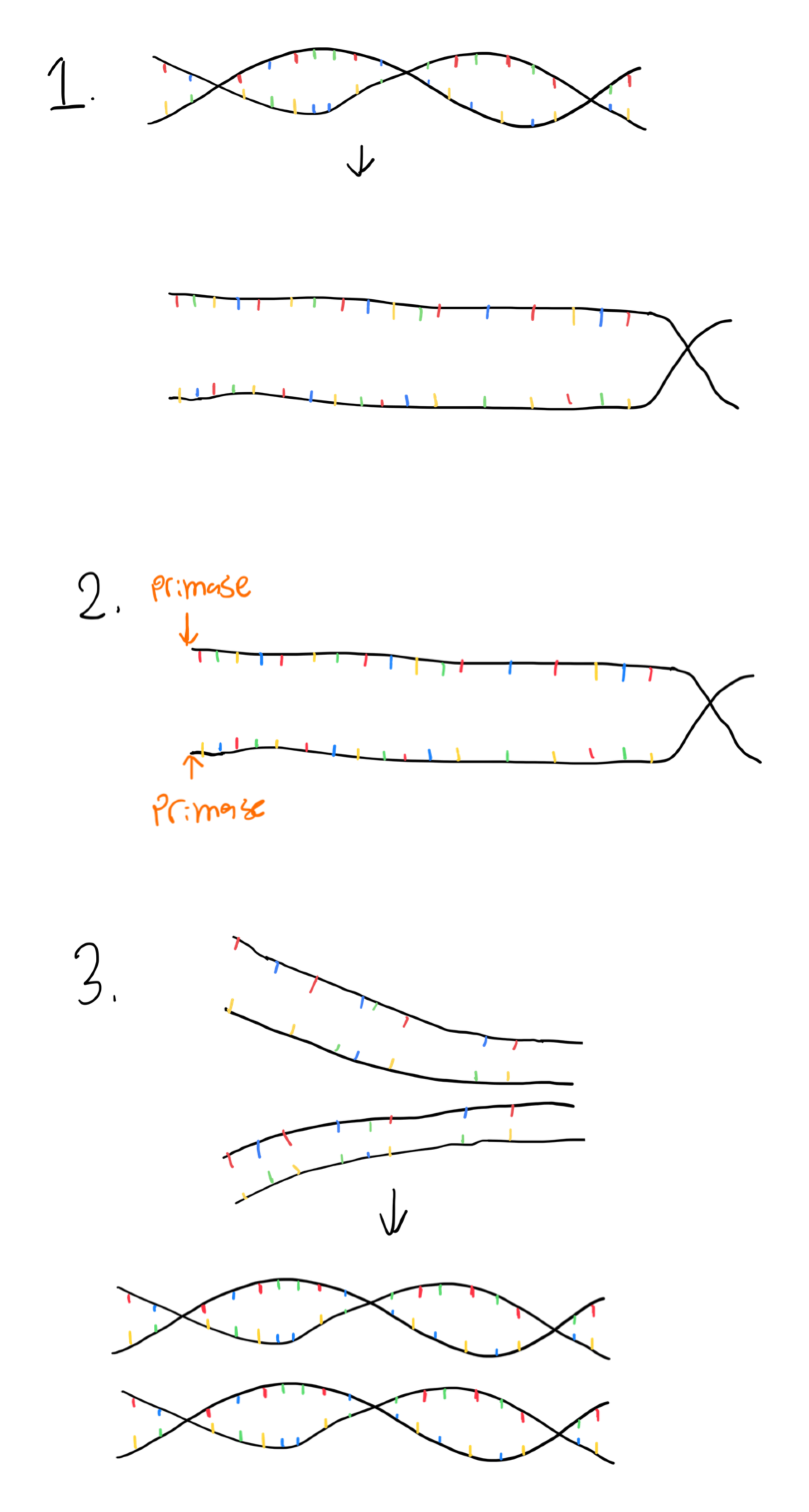
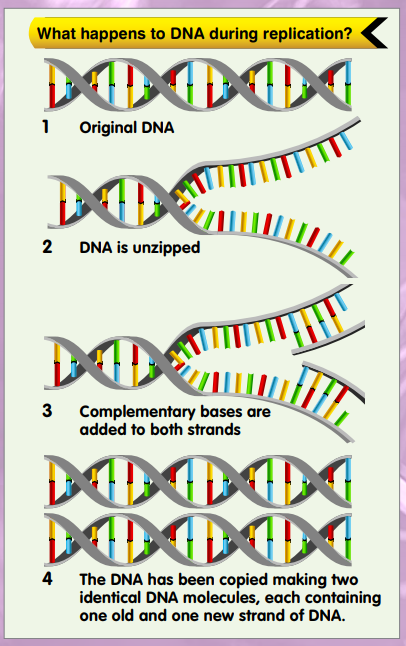
Draw and label a diagram to show how DNA replicates
Some useful enzymes (remember one for the exam):
- Polymerase: Clones complementary DNA ATGC’s. (Extra info: only builds in 5’ 3’ direction, ligase seals ogazaki fragments together)
- Helicase: Unzips by ripping through hydrogen bonds
- Primase: Tells polymerase where to start working
- Ligase: Glues DNA fragments together
Explain the difference between DNA and genes
DNA is the complete molecule that stores all genetic information about an organism, while a gene is a segment of DNA that codes for a specific protein or function.
Explain how genes are expressed in simple terms ie they code for the synthesis of specific proteins
3 genes make up a “triplet” in DNA or a “codon” in mRNA. These 3 genes code for a specific amino acid, and combining amino acids in a specific order creates a protein.
Button blue