Exercise 6A - Trigonometric Ratios
Trigonometry is built upon the three ratios: , and . These ratios do not change for triangles that are similar in shape.
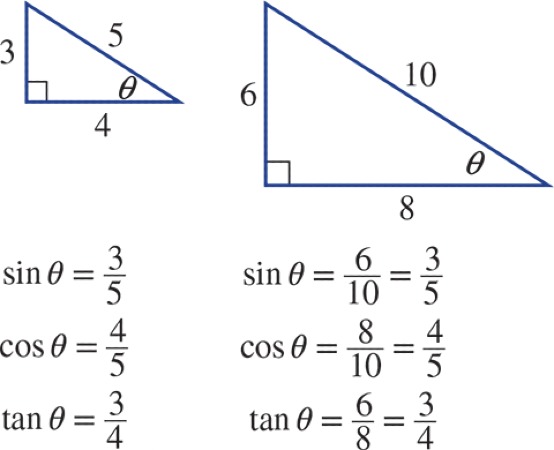
Do you see the pattern? It’s SOH CAH TOA. , , .
is the opposite side from , is the adjacent side to , and is the hypotenuse.
It’s basically just algebra to rearrange and find the side lengths. E.g.
or,
six seven.
Exercise 6B - Finding Unknown Angles
Basically the same as 6A, but now like multiply has its inverse: divide, and square has its inverse: square root, any trig operation has it’s inverse: , , . Then it’s just algebra. Trying to find the angle that has two sides of a certain length?
Exercise 6C - Angle of Elevation and Angle of Depression
It’s kinda self-explanatory, make triangles using the ground, sky and sea. Elevation always goes up to the left or right, finding the angle between the ground/sea/whatever and your line. Depression always goes down left or right from the sky, finding the angle between the sky and your line.
Exercise 6D - Directions and Bearings
True Bearings
A true bearing is in the format , e.g. . Be sure to preface with 0 if less than three digits for bonus marks.
Compass Bearings
Compass bearings are weird and they weren’t in the exercise, but whatever.
Basically, they’re in the format , North or South must always go first and be in relation to East / West. E.g. , so the angle you’re looking for is anticlockwise from North (that is, towards West), i.e. a true bearing of 304°T.
I can’t be bothered writing more examples, good luck
Exercise 6E - 3D Trigonometry
Nothing new, just make diagrams to help.
Exercise 6F - The Sine Rule
Use the sine rule when there is a ‘butterfly’ in the triangle.
LOOK NATHAN IT WAS MY TEACHER OK, I don’t mind it
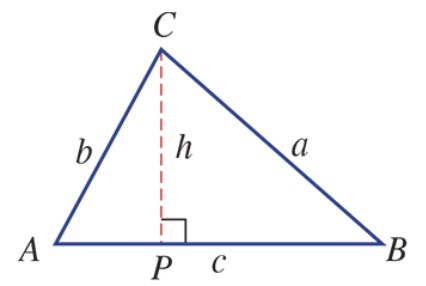
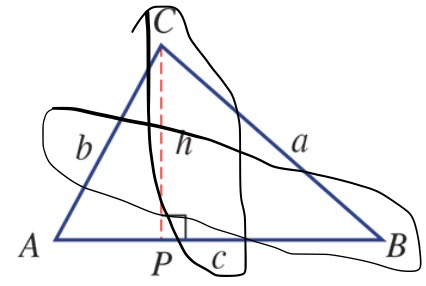
When to Use the Sine Rule
- When you have two angles and one side
- When you have two sides and one angle
Finding a SIDE with the Sine Rule
Use the formula:
Where capital letters are angles and lowercase numbers are side lengths.
Finding an ANGLE with the Sine Rule
Use the formula
Where capital letters are angles and lowercase numbers are side lengths.
Note
There are sometimes two angles, for acute vs obtuse triangles. Just do to find the obtuse version.
The and have to match up, as do and .
Exercise 6G - The Cosine Rule
Use the cosine rule when there are
- two sides and an included angle
or - three sides
Finding a Side With the Cosine Rule
Finding an Angle With the Cosine Rule
Note
Note, all the lowercase and uppercase letters have to match up together.
Exercise 6H - Sine Area Rule
The Sine Rule for area can be used to find the area of a non-right angle triangle. the formula is:
A = \frac{1}{2}ab\sin c $$Where $c$ is the included *angle*. # Exercise 6I - The Unit Circle This is a really bulky topic with a lot to remember. [This page](https://www.mathsisfun.com/geometry/unit-circle.html) offers a pretty good summary with a nice visualiser. ## Part 1: Positive or Negative? So, in a Unit Circle, is $cos(230)$ positive or negative? Positive, right? **WRONG**, it is negative. Why? Let me explain. Values of $sin$, $cos$, and $tan$ are positive or negative depending on the quadrant. Remember *ASTeC* (Aztec) **A**ll **S**ine **T**angent **C**osine I.e. in the first quadrant, all are positive. In the second quadrant, only sine is positive, etc. So $cos(230)$ is in the third quadrant and there, only $tangent$ is positive, so $cos(230)$ is negative. ## Part 2: What's the Angle, Really? Sometimes, you get asked 'If $θ$ is acute, find the value of $θ$, given $sin(150)$.' And Unit Circle throws another curveball. So, let's revise. If the angle given is in the **first quadrant**, then you've got it already, easy. If the angle given is in the **second quadrant**, then you do $180-a$ So then, logically, if the angle given is in the **third quadrant** you do $270-a$, right? **WRONG!** It's $a-180$; if you think about it it makes sense. If the angle given is in the **fourth quadrant**, then you do $360-a$ because maths hates you. # Ex6J - Trigonometric Graphs ![[image.jpg]]![[image 1.jpg]] Sometimes a question will be like, "Considering a graph, is $sin(30)$ larger or smaller than $sin(230)$?" And yes, you could use the graph to find the answer, or, you could use a calculator. It's so much easier. # Ex6K - You need to memorise the $sine$, $cosine$ and $tangent$ exact values. That's basically it.