Ex3A - Review of Index Laws
Ex3B - Negative Indices
Example
Say you need to simplify , follow the steps LOGICALLY
Ex3C - Scientific Notation
Significant figures are counted from left to right, starting at the first non-zero digit. E.g. to 3 significant digits is
Using scientific notation, it is easier to describe huge or minuscule numbers. E.g. it’s difficult to write out 1 trillion as while in scientific notation, it’s simply
Combining significant figures and scientific notation, say you want to express the weight of a (fictional) dinosaur you found dead in a cave in grams. It’s very inconvenient to write that it’s precisely grams, and, besides that, who needs to know about the extra grams? Using scientific notation, you can say the dinosaur is grams.
Ex3D - Fractional Indices
Also,
Ex3E - Exponential Equations
Without knowing Logarithms, the only way to solve exponential equations without guessing is providing the same base for each exponential, then solving from there.
Example
Ex3F - Exponential Functions and Their Graphs
Just uh, don’t be dumb. This is not worth writing notes for IMO.
Ex3G - Exponential Growth and Decay
This is a pretty simple one, just use this formula:
E.g. a ring is valued at \10005%$ per year.
Where is the number of years.
If something will decrease in value, e.g. a car is valued at \5000010%1-r$.
Where is the number of years.
Ex3H - Logarithms
Logarithms are used to find the power of a number. E.g. if you want to know what power you have to raise to in order to get , you can use logarithms!
It’s super useful, for maths problems. There are a few other things to know. Here is a useful way to convert between exponential and logarithmic form:
Just shuffle it around to get the answer. E.g. to convert from logarithmic to exponential:
And vice-versa.
There is also another method to do the same thing, but it’s a bit weird and you might not want to use it.
Then the cancels out the in , and , leaving you with . I don’t really get how it works, but apparently it does.
Useful Tips
To solve something like , then just do , it’s the same thing.
To solve something like , just do , it’s all just shuffling numbers around.
Ex3I - Logarithmic Scale
The logarithmic scale is pretty simple, it’s always in , so instead of having a graph like:
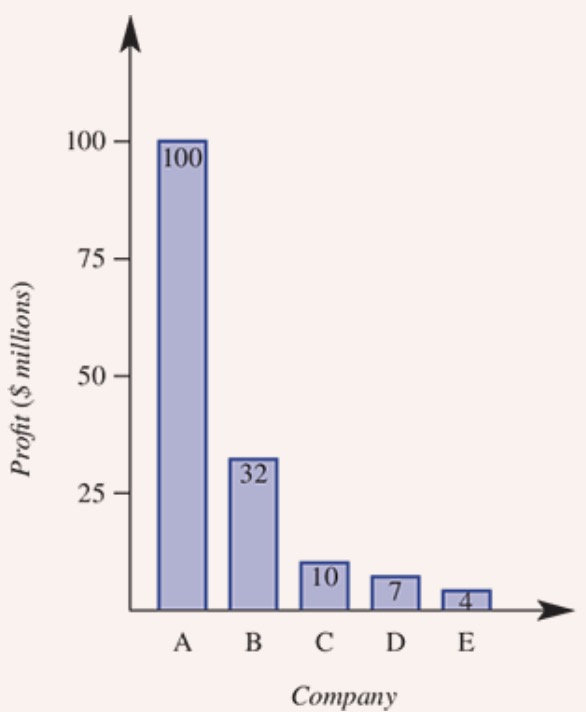
You’ll get something like
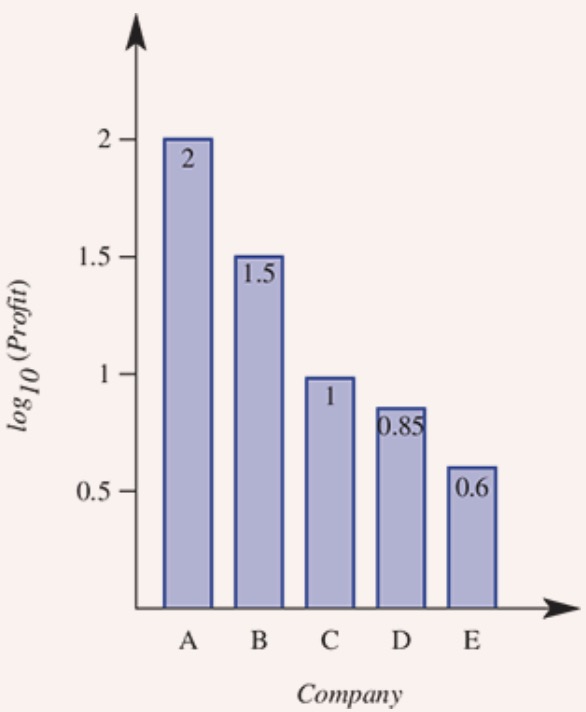
It looks much cleaner, but you have to remember that it’s all using exponents, so every number is a lot different to how it looks.
Key Skill 1
A key skill is converting a table of exponential values into values. E.g.
| 0 | 1 | 2 | 3 | 4 | 5 | |
|---|---|---|---|---|---|---|
| 20 | 200 | 2 000 | 20 000 | 200 000 | 2 000 000 | |
| 1.3 | 2.3 | 3.3 | 4.3 | 5.5 | 6.3 |
Key Skill 1.5
Then, make a graph from those exponential values.
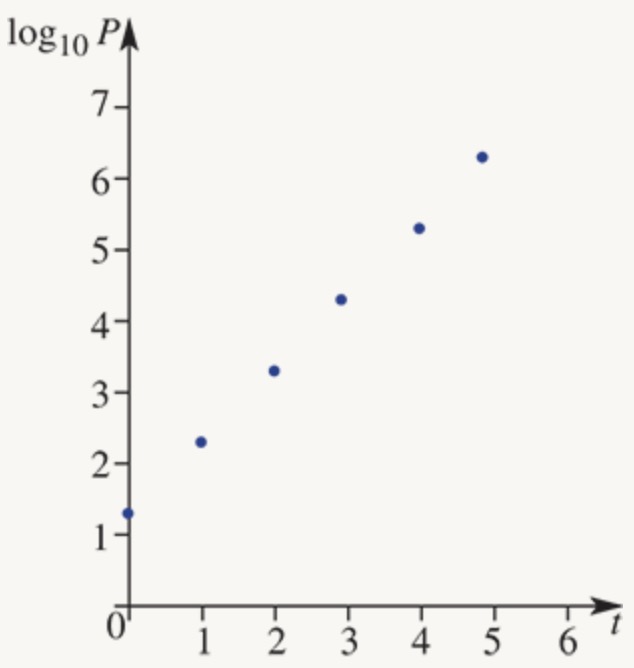
Key Skill 2
Another key skill is interpreting a logarithmic chart, a few example questions should jog your memory.
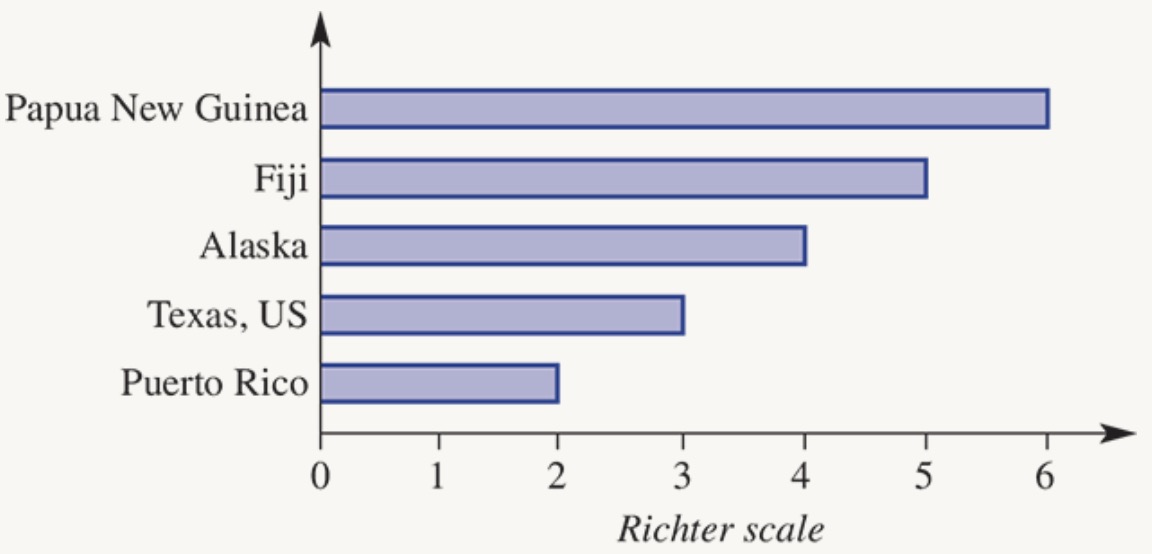
a) What is the difference between the magnitude of the earthquakes for Papua New Guinea and Texas, US?
b) How many times more powerful was the earthquake in Papua New Guinea than in Texas, US?
Ex3J - Log Laws
These are actually really similar to index laws, and kind of intuitive if you can think hard enough about them. Just remember the basics and you’ll be alright.
Rule 1: Addition -> Multiplication
I.e. when two logs are added together, just multiply their bases and put it in one , so long as the argument is the same ().
Rule 2: Subtraction -> Division
I.e. when two logs are subtracted, just divide their bases and combine it into one .
Note: when solving something using the ‘basing’ method
Rule 3: Powering Bases
I.e. nvm, figure it out yourself
Rule 4: Base 10ing
Where can be or pretty much anything else*.
*I think
Useful for calculators where there's no way to input an argument for the $\log$.Rule 5
Rule 6
Rule 7
Then just apply those rules to various situations and boom, you’re all good.
Ex3K - Using Logs in Equations
Dead easy, just do some practise questions from the chapter, remembering all the log laws in Ex3J - Log Laws.